






Show Notes
“I know what to do, but I can’t get myself to do it.” If that thought has been looping in your head, there’s a good chance you don’t have a motivation problem. You have a misalignment problem. I’m joined by my personal mindset coach, Brad Bizjack, to redefine what success actually means and to map a clear path for creating it without burning out or feeling like you’re failing at life.
Brad shares his simplest definition of success: life on your terms. We talk about how easy it is, especially for women and moms, to lose touch with what we want under layers of responsibility, people pleasing, and guilt. Brad gives practical questions to uncover the desire that’s already there, plus a way to tell the difference between a goal you truly want and a goal you inherited from society, family expectations, or old “be realistic” programming.
Then we get tactical with Brad’s “combination lock” framework: the right strategy matters, but it won’t stick if your beliefs and values are in conflict or if your nervous system treats growth like danger. We reframe self sabotage as self preservation, share quick tools to lower guilt and shame (including why empathy and community matter), and dig into energetic alignment in a grounded, practical way so you can take more aligned action with less stress.
If you want a next step, Brad is hosting a free five day Success Accelerator challenge October 19 through 23, and you can register at bicepsafterbabies.com/success. Subscribe, share this with a friend who feels stuck, and leave a review with the biggest takeaway you’re applying this week.
Introduction
You're listening to Biceps After Babies Radio episode 418.
Hello and welcome to Biceps After Babies Radio, a podcast for ladies who know that fitness is about so much more than pounds lost or PRs. It's about feeling confident in your skin and empowered in your life. I'm your host, Amber Brizicki, a registered nurse, personal trainer, wife, and mom of four. Each week, my guests and I will excite and motivate you to take action in your own personal fitness as we talk about nutrition, exercise, mindset, personal development, and executing life with conscious intention. If your goal is to look, feel, and be strong and experience transformation from the inside out, you, my friend, are in the right place. Thank you for tuning in. Now let's jump into today's episode. Hey, hey, hey, welcome back to another episode of Biceps After Babies Radio.
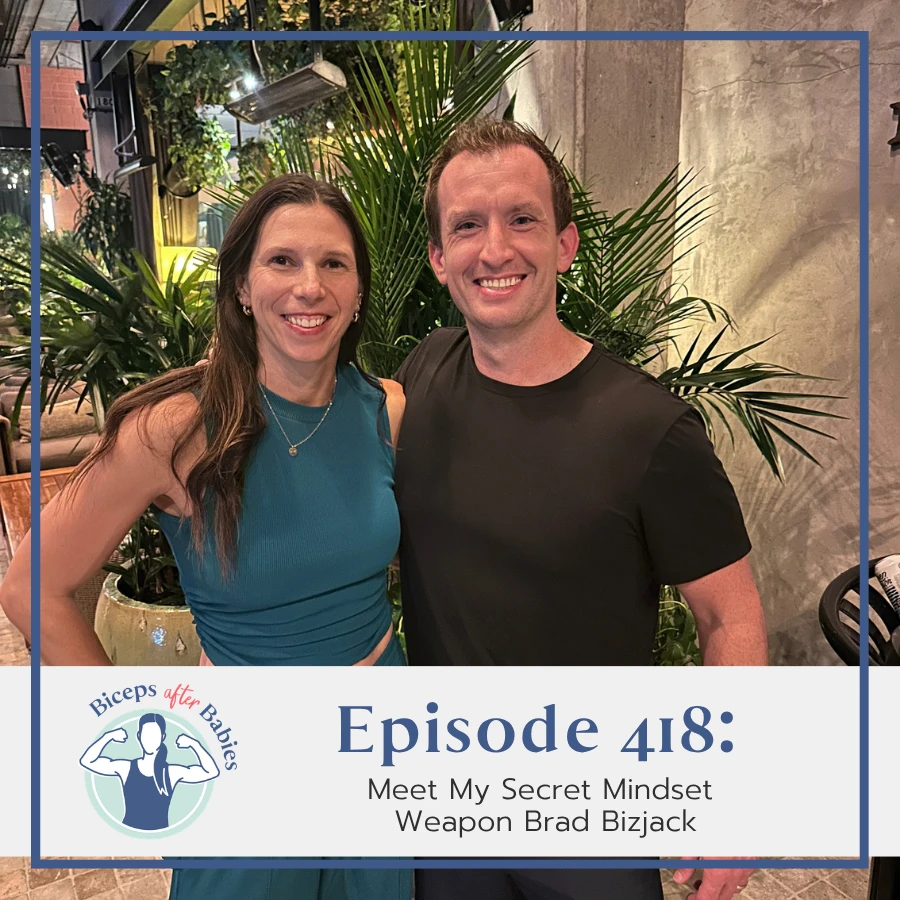
I'm your host, Amber Briziky, and returning to the podcast is one of my favorite guests, my own personal mindset coach, Brad Bizjack. So I've worked with Brad, let's see, I've known Brad for I think at least four years, and I've worked with him for the past three in both paid coaching mentorship as well as just a friend. He's he's definitely my mindset guru. He's who I call if I'm ever in a rut or I feel stuck or I feel like I have some resistance in the goals that I'm going after. He is my go-to. He's who I call, he's who I am my resource. And so I'm so excited to be able to have him on the podcast today and be able to share a little bit of his wisdom with you. So today we're talking about how to create success in your life. And I know that that's a really broad topic. And we actually dive into that at the very beginning of the episode, where we really create a definition for what success means. Because I think that that's really important. Success is not a one size fits all. And I think it's really easy to think about success in the realms of making more money or becoming more famous or losing more weight or having the perfect body. And Brad is really quick to redefine success on your own terms. And we have a really good conversation about what success actually looks like and how you can go after the success that really matters to you. And then from there in the conversation, we talk, you know, spend most of the conversation about, okay, once we've identified what success looks like for you, the outcome, the goal that makes your heart excited and makes your heart sing, then how do we create that? How do we work backwards to be able to create that success? And how do you help yourself honestly like get out of your own way? Because oftentimes the thing that is blocking you from your success is your brain. And so Brad is a whiz in being able to help you to work with your brain in order to make success easier and remove the obstacles that are in the way that are preventing you from that success. And listen, if you listen to this conversation between Brad and I and you get excited and it inspires you, and you have this pull to work towards some of your goals and to maybe work with your brain to be able to make success more possible for you in the future. I cannot recommend Brad's upcoming five-day success accelerator challenge. It's phenomenal. I've gone to it multiple years in a row. I've had lots of clients who've gone to it. And everybody who goes comes away with more excitement and more tools to be able to work towards their own individual goals. So that is October 19th through the 23rd. It's free. And you can go to bicepsafterbabies.com forward slash success to register. That's bicepsafterbabies.com forward slash success and come join Brad and I in his upcoming five day challenge. Now, without further ado, let me introduce you to my own secret weapon, Brad Bizjack. I am so excited to welcome Brad back to the podcast. Hey, Brad, you're like a regular now on the podcast.
Brad Bizjack 03:57
Super glad to be back, my friend. Thanks so much for having me. It's gonna be a lot of fun, gonna add a ton of value. It's gonna be great.
Amber B 04:02
Yeah, super excited to have you. And I always love sharing, you know, my own little secret weapons with my audience. And I would say that you're one of my zero weapons, Brad. Like, you just call me a secret weapon? You're the secret weapon. That's a huge ego boost. Thanks for saying. We're starting off high. We're starting, we're starting high and going from there. Yeah. Brad has been when I need help and I need someone to like give me a different perspective. I need some mindset help. I feel blocked. I call up Brad and then he gives me a the one-two and I walk off better and able to execute. All right.
Brad Bizjack 04:38
I'll be the secret weapon today. That sounds great.
Amber B 04:40
Okay. So let's well, let's just do a quick introduction for anybody who maybe has is new to the podcast or hasn't been around. Just introduce yourself a little bit about who you are and what you do and how you help people.
Brad Bizjack 04:52
Yeah, for sure. So my name's Brad. Hi. Um, we help people rewire their mind for success. And really what that means is we take a look at what you really want to go after and we identify any subconscious patterns, blocks, limitations, limiting beliefs, fears, doubts, emotional patterns getting in the way of that coming true. And at a subconscious level, meaning under your awareness, we go in and we remove that so that there's no more inner conflict where it's two steps forward, three steps back. Like if you've ever been like, I know what to do, but I can't get myself to do it, or you're doing everything, but it's not actually, nothing's actually changing, or you're not experiencing joy and happiness along the way. And you just want to know how do I succeed more while being fulfilled? That's what we specialize in. It's not your typical mindset stuff. Like the word mindset, I've noticed this a lot. It gets thrown around in this industry a lot, but you can just chat GBT mindset stuff now, right? We really exist to go beneath the surface to the blind spots that people can't see and remove those through an experience that will help people come alive and actually be fully aligned with their next level. So that's a little background.
Amber B 06:03
That's awesome. Yeah. So I I want to start the conversation today because we're gonna talk about what this looks like and how maybe you can start to become aware of some of these things in your in your own life on things that you're getting stuck on. But I want to start with just even backing up and creating a definition, like a shared definition for what success is. Because we're gonna talk about how to create success in our life. But I think that we even have to start with just like that, the definition of the word success, because I think it can be in different people different things in different contexts for different people. And so when you talk about, hey, I'm gonna help you create success by removing these blocks, what are you what do you mean by that?
Brad Bizjack 06:39
It's a great question. And success is such a subjective thing. I think a lot of times when people hear the word success, they think of what society has deemed successful, like the material things, right? Like money and a large business or whatever it is. And those can be included in it. If I were to put a definition of success into one line, it would be life on your terms. Like life on your terms. What is what are you doing? Where are you doing it, with who are you doing it, when are you doing it, and are you enjoying it along the way? That would be my definition of success because who the heck am I to tell you what to want? Yeah, I'm here to help you find what you want. But it's what does a life on your own terms look like in every category of your life, not just one area. And how do we make sure life is firing on all cylinders? That to me is what success really is.
Amber B 07:26
I love that. How do you because I so let me let me back up when I ask this question and kind of tell you why I'm asking it? A lot of people who listen to the podcast are female, and a lot of those females are moms and wives and partners. And there is definitely a societal programming about taking care of other people above and beyond before taking care of yourself. And so when I start to work with clients and we start to dig into their goals and dig into their dreams and dig into their aspirations, a lot of times it is shoved very far down to the point that they don't even know what they want, right? You ask them the question what do they want, and they like look at you like a baby deer. Like, I don't know. Like I want to take my children to soccer practice, like I want to make dinner for my family, right? And so there's like a, there's a lack of even like even giving themselves permission to even want something that it's hard to uncover. And then there's a lot of guilt that comes up because there's again this programming that if you're doing something for yourself or if you're going after your goals and ambitions, then that's selfish. And that's the, you know, the worst thing a woman could be in our society is selfish. And so I just I wonder if you could speak to that a little bit for anybody who's listening to the podcast who feels a little lost, feels like they've lost a little bit of themselves as they've gone through child rearing or becoming a partner, or just being, you know, told by society that like women are, excuse me, women are supposed to be small and you know, not not rock the boat. Can you just speak to that woman for a minute?
Brad Bizjack 08:58
Of course. Women are the powerhouses of society. Like I no one would exist without women. Yeah. Like it like so much respect. I'm gonna say something bold that, you know, I think it and it goes off of what you said about, you know, we can't be self-women can't be selfish. You being selfish is one of the most selfless things you can do. And I'll explain what I mean. I don't mean it's all about me. I mean putting yourself first is the only way to actually fully take care of those that you love. And you mentioned the word guilt. Guilt means you violated a personal standard, but no one really stops to ask themselves if their standards are actually in alignment with the life they want to live. Right? So if your standard is everyone else comes first, if your standard is I come last or I'm not worthy of taking care of myself, of course you're gonna feel guilt. Of course you're gonna feel down about taking care of you. But when was the last time you actually checked what your personal standards are? Yeah. If your personal standards were brought up through conditioning, and most of them are, chances are they're not actually in alignment with what your dreams really are. And plus, let's think about this: putting yourself, yourself last or so far down that you need permission to take care of you. Let's actually look at the true consequences of that. Like there's the whole, I know, I know, I gotta take care of myself, all that. But there's actually a downstream effect that's far more toxic of continuing to live this way. If your household does not receive the best version of you, think about what happens to your kids' self-confidence. If you're showing up exhausted, if you're showing up snappy, if you're showing up not healthy, not taking care of yourself, and you are not proud of yourself, you're not celebrating yourself, you're not showing your children to put them first and their needs first. To I'm not saying don't be selfless in other ways, I'm not saying don't care about other people, but if you don't show people through your actions to take care of you, you are literally training your family that they are not worthy of taking care of themselves. And think about what that does down the line. If you think about where any great change happens in a family, families were always dealing with some sort of hardship until one person came along and said, This ends with me. The change starts here with me. That was me and my family, and it was it's just different from here, go forward. And a lot of people fear that if they take care of themselves, they're not gonna be able to have time to take care of everyone else. What you'll notice is that instead don't look at it from a perspective of time, look at it from a perspective of true and total presence and pride. Your kids, your family, they don't listen to what you say, they watch where your feet move. And so if you're saying one thing and doing the other, you're training them to not actually do the thing that you're saying. So then the question becomes if you're saying I don't know what I want, and this kind of gets into our main topic for today. I guess we can go there if we want to next. What would you go after if you had three times the courage and three times the energy? And you find that I you answered that question. I'm willing to bet you do know what you want. I have yet to find one person in literally training 80,000 people. I have yet to find, and granted, all of them were not one-on-one conversations, but I have yet to find one person in literally thousands of one-on-one coaching sessions that doesn't know what they want. It might take some digging, but the repetitive story of I don't even know what I want reinforces itself and it gets stronger and it becomes a conviction. That conviction becomes a belief. And that becomes the field of vision that you have for everything in your life. So I'm willing to bet you absolutely do know what you want, but there is likely a fear of claiming that because you perceive that there's going to be some sort of pain attached to going after it.
Amber B 12:57
Yeah, that makes sense. So if somebody is sitting here, maybe a little resistant to this idea, because they've been repeating that story of, I don't know what I want, I don't know what I want, I don't know what I want. I love the question. You know, if you had three times the courage and three times the energy, what would you go after? I think that's such a great question. Are there any other questions that somebody who's sitting here listening could use to elicit what it is that they deeply want? Because what you're saying is like it's in there. No one has to put anything in there. It's in there. You just have to find it.
Brad Bizjack 13:27
Yep, absolutely. So let's start here because I think this will have the least amount of resistance. What do you not want?
Amber B 13:35
Yeah.
Brad Bizjack 13:36
And if you start with what you don't want, I am willing to bet that there is an opposite to that. Right? Yeah. And so so if we know what you don't want, that means by its very nature, you know what you do want, because if that wasn't present, you would have what you wanted. Right. And so let's start there. What do you not want in your life? And if you would to pick the antithesis of that, the exact opposite, not just a little bit better, but the exact opposite of that, what would that look like? If life was truly firing on all cylinders, and there was no pain that you perceive would happen if you went after any of your goals, what would you go after? A lot of times people have this upper limit perceived ceiling because it's not because they don't want more, they don't claim the goal because there's this perception that if I go after this, I'm going to lose something. I'm not going to be as good of a mom. I'm not going to be as good of a spouse.
Amber B 14:29
Yeah.
Brad Bizjack 14:30
Well, let's put that limitation aside. If there was no pain associated with going after something, what would you actually want? So those three questions I think could help.
Amber B 14:39
I love that. Okay. So if somebody has done this now and they have figured out, okay, this is what I want. This is my definition of success. And I love that we're we're figuring out everyone's individual definition, right? It's gonna look different for everybody. But your individual definition for success, and you know, someone's said that, they've put it out into the universe that this is what I want to create. Now, what are the steps and how do we work backwards from being able to create that?
Brad Bizjack 15:06
Yeah, that's a great question, Amber. You ask really good questions. So we need to start here though, because and I I view success kind of like a combination lock, right? I view that there's there's three numbers. Like imagine those old combination locks, the little dials are like on the briefcase, like and it opens up and it pops open. Well, your definition of success, what whatever that is, there's three numbers that you need to unlock. First, I want to spit spend a little bit more time on the lock itself, which is what does success look like. Because if you're like most people that I've worked with, there is a conditioning to be realistic. There's a conditioning to claim less than you want, there's a conditioning to claim something based on past mistakes or past failures. And all that's gonna lead to is more of the same. And because the you're literally basing the future on the past. The brain can't play, it can't predict the future. So it calls on the only evidence it has, which is the past. And if you're using the past to predict the future, then you're recreating the past over and over again. So I love the quote: the past becomes the future when you live there. And most people, they're trying to open this combination lock without ever asking the question, is this the lock I want to open? They're climbing this ladder of success in life without ever asking, is this leaning up against the right wall? Because if I'm spending all this time, all this effort trying to open up this lock, but I don't actually want it, you'll notice that there's automatically a lack of inspiration to take action. You're gonna feel flat. Even if you do get it open, it's not gonna feel like it's ever enough. You're gonna feel exhausted. And I'm sure people listening have had that experience where they check off something they really wanted to check off, and it just felt like relief instead of joy. And it wasn't enough. And it's likely because it was the wrong number. And it comes back to that question: what would you actually go after if you had three times the courage and three times the energy? And it takes ridiculous self-honesty because if you are going after opening up this metaphorical lock, and it's not what your heart actually wants, you're asking for a lack of fulfillment. And if you have achievement without fulfillment, you just found the greatest failure in life. And so we don't want to achieve without being fulfilled. We want to feel alive as we're achieving. And that only comes when you are going after something that you really care for. Now people say, Well, what if I fail? What if I succeed? What if I lose this? Right? Well, you don't set goals for the certainty of attainment. It's not about hitting it. It's not, I I miss almost every single goal I set. It is not about actually hitting the goal. It's does this dream raise your energy and allow you to change who you are so that you're actually making progress in a way that fulfills your spirit. And that is the that's how you know the goal is the right fit for you. If it makes your heartbeat faster, if you makes your butt pucker a little bit, right? That's that's the type of goal. And it doesn't matter if you hit it. If you tie your worth to an outcome of a goal, you're missing the point. So we need to just make sure before going into these three keys that the lock is actually the lock that someone wants to open. Does that make sense?
Amber B 18:13
Yeah. Yeah. And how would you, I guess my question in that is how would you differentiate between the lock that you really want to open and again, like societal programming or what your parents value, or you know, what society deems worthy of you? Like, how do you separate that out of your heart's desire versus conditioning?
Brad Bizjack 18:34
You will have a physical reaction when it's what you want. You will literally notice. I've seen this literally thousands of times. When someone's claiming what they don't want, their energy is down, their shoulders are rounded, they're kind of down like, you know, and I'm on camera right now, but I'm leaning forward. And then the minute that they claim what they actually want, their shoulders go back, their energy just shoots up. You can see it. So if you notice a physiological change in your body, yeah, the higher energy, your voice goes up. If your breathing gets faster, your shoulders go back when you're talking about it. You notice a surge, that's how you know it's right.
Amber B 19:09
Love it. Love it. Okay, so we've figured out what it is, we figured out what the combination is, the lock itself is. Sorry, we figure out what the lock is. So then what how do we start working backwards from figuring out how to open that said lock?
Brad Bizjack 19:22
Yeah, I I'll I'll go in reverse order of what I perceive as most important. Now, all these numbers matter, they all need to be correct for the lock to open. But what most people do when they have a dream or a goal is they start with one simple question, which is how do I do it? Yeah. And because you haven't done it yet, you don't know how to do it. Right. So there's a lack of certainty that shows up. And when there's a lack of certainty that shows up, there's confusion and typically inaction. And we sit there, twiddling our thumbs, not really going anywhere. And so most people start there. They start with how? How do I do this? And how is an important question. You need to know how, right? If you eat pizza and ice cream and beer all day long, and you barely exercise, you are not going to be in the best shape. Right. Right. That is, yeah, right. There is a there's a strategy for success, there is a a science to achievement, there is a way to do it. You can't head east looking for a sunset, right? So the strategy deeply matters, right? It matters, and we have to make sure we have the right strategy. But let's just say for a second that someone has the perception that taking care of myself means losing my family. Are they going to follow the right strategy? No. No. If someone believes that I'm not worthy of taking care of myself, if someone believes that, you know, I'm just big boned and it's not gonna happen for me, right? Like they're they're gonna not apply it all the way. And so the third number down is the strategy. I don't really spend a lot of time in the strategy, right? There are experts that teach you amazing strategies. I like to go behind the scenes and deeper because and and here's one important caveat to this: you can use the strategy and have results. You can force yourself to get results with the strategy, but we want to make sure that it's actually success on your terms, life on your terms, which means that you're experiencing joy and fulfillment along the way. If you have inner conflicts holding you back from experiencing joy and fulfillment on the path to this success that you're after, then you can achieve all day long, but you won't be fulfilled. So I like to stay below the surface. I like to stay in the subconscious mind, sub meaning under conscious meaning awareness, what's going on in your mental blind spots that you can't see. So the first thing, or I guess third thing that I would look at is the strategy itself. Do you have the right strategy? And a way to know if you need work here is if you are experiencing genuine. Fulfillment consistently, you're experiencing presence, happiness, and joy, you're taking consistent action towards your dreams, and it's not happening, that's a sign you likely have a strategy problem. That's a sign we need to go and check. Okay, what can we dial in a little bit more? What can we change? But I've worked with a lot of people, and what I've noticed is if someone's really, really stuck, not going anywhere, they typically aren't applying the thing or they're not happy, they're not fulfilled, which leads to the second number. And that is your inner conflicts in your beliefs and values. Those need to be eliminated. Your beliefs and values need to be in alignment with the dream that you have. And so allow me to explain what that means. A belief is a feeling of certainty. That's all a belief is. And here's the crappy thing about beliefs, you believe them. Right? Yeah, you believe beliefs, which is why they feel like absolute truth and they're not. Like like everyone here can agree the sky is blue. But what about at night? What about during a sunset? What about during a sunrise? What about when it's about to storm? What about the scientific answer that it's not any color, it's just light being reflected, right? So the belief the sky is blue just was presented with evidence that it's not. And so if you have a belief that says, if I take care of myself, I will not be a present mother, that is an inner conflict that's going to get in the way of you applying the strategy fully. If you have a belief that says, I'll never be successful, or it's not in the cards for me, and that is a feeling of certainty and a conviction in you. You likely have decades of evidence to back it up, but it is quite literally that just a feeling of certainty, and there's evidence to say the contrary. At the same time, there's your values. Your values are emotional states that you want to move forward towards or move backwards away from, right? And without getting too much into the weeds of values, values show up in conflict when you feel like it's two steps forward and three steps back. So if you ever had the experience of starting really strong with a macro plan and going to the gym and all these things, and it goes really well for two weeks, and then just life happens to get in the way, right? It's typically a values conflict. There's typically some sort of inner conflict getting in the way that's causing that sort of procrastination or what people label as self-sabotage. And I'll explain that word self-sabotage. I have a very interesting take on self-sabotage. I believe self-sabotage is physically impossible. And allow me to explain really quick. Your brain is amazing. It's just blows my mind what it's capable of. It's the best supercomputer in the world. And its number one job is not to make you happy and successful. Its number one job is to make sure you stay alive. That's its job. You touch a hot stove, pull your hand away. So the way that it predicts what is not a threat to your survival is through what is familiar. That's how the brain knows it's safe. Familiarity. And so it's always scanning for threats. So if something is unfamiliar, it is deemed a threat. If procrastination or not taking action or beating yourself up or anxiety or whatever it is, if that is familiar to the brain, even though you don't like it, it is what the brain knows to be safe because you know how to handle it. When you start thinking about taking care of yourself, putting yourself first, exercising, eating right, all these things, that may be completely different and unfamiliar to the brain. So the brain goes, Whoa, whoa, whoa, this is out of our normal course of action. This is unfamiliar. This is unsafe. This is a threat. This might lead to death. So now your brain's going, exercise equals death. And so nutrition equals death. I don't want to stay consistent with this. So I'm going to quote unquote sabotage. It's not sabotage, it is self-preservation. It's staying in alignment with what your identity knows to be true. And the strongest force in the human personality is the need to stay consistent with who you already think you are. So this shows up in so many ways. If someone values, let's say, success, but they equally value avoiding rejection, there's a conflict. If someone values freedom, but they also value avoiding judgment, there's a conflict. And if we think about uh values as emotional states, now let's say we value our family, yes, but what does that lead to? The value of love, right? Like what's the end emotion? If we think about what emotions it would take for us to take the actions we want to take, like who's going to actually take more action? Is it the person that's anxious and stressed or the person that's grateful and passionate, right? Obviously the latter. But what does it take for you to be in this example grateful and passionate? Typically, there's beliefs about what it takes to elicit a value. And most people don't recognize those are playing behind the scenes, preventing people from utilizing the strategy in the right way. So if we really want this to take hold and us to have rocket fuel on the strategy with fulfillment and joy, we need to make sure and resolve the inner conflicts of our beliefs and values that are causing us to go two steps forward and three steps back. Now, before I keep going, I'm sure you have questions or thoughts.
Amber B 27:33
Yeah, no, it's so good. And I think the idea that there's a purpose behind the self-sabotage is one that can take a lot of the guilt and the shame away from that experience that a lot of people have. Because I think a lot of people do really struggle with saying, well, I know what to do, but I just don't do it. And so then we turn that around and feel really guilty about that, feeling really shameful about that, which just like perpetuates the cycle even further. And so I think understanding that there's a purpose behind it, like there's a reason that you're doing it, it makes perfect sense that if you have this conflict in your values, why your brain would resist doing the thing that you consciously say that I need to do. So I think that that can just like relieve a lot of anxiety that people have about the fact that they're bad or wrong or just not capable of doing it and being like, no, this is like biological. And when we can understand it, we can work with it.
Brad Bizjack 28:24
Can I give a tool to help with that? Of course. So a little bit of context. Have you followed Brene Brown's work? Oh, yes. I love her start on machine. It's amazing. So just a very 60,000-foot level. Guilt is I did something bad. Shame is I am bad. Yeah. Right. And and I highly recommend Brene Brown's work for anyone here that you know is dealing with guilt and shame and deals with struggles of vulnerability. 10 out of 10 recommend. It's it's fantastic. So this idea of guilt, we talked about the personal standard side of things. Shame is a whole other animal. And it's this idea of I am bad. And shame only exists in isolation. That's the only place it exists. So what most people do when they're getting in their own way, so to speak, is they tend to go huddle in a corner. And that's the exact opposite of what needs to happen when you're experiencing shame. So there's two tools that I want to make sure and give you if you're dealing with that guilt and shame. Number one is thinking about the brain and the guilt side of it. You mentioned it's a biological function. Absolutely. So what you can do is step one is being in non-resistance to the brain's job. And I'll give you a tactic on how to do that in a second. Whatever you resist persists. So if we are resisting the brain doing its job of protecting you, it'll actually double down and resist the resistance grows, right? To the degree in which you can accept what is the degree in which you have the ability to change it. So when the brain does that, not a matter of if, like everyone does this from time to time. It's human. When that happens, my challenge to you is instead of judging yourself, thank your brain. Say, and literally do this out loud, thank you for trying to protect me. And just notice what happens to the pressure gauge. It goes down instantly when you're in gratitude for the brain doing its job instead of self-punishment because it's perceived as a you thing and it's not. But the second thing when that comes up, that experience of shame comes up, the gut reaction to protect ourselves is to go into isolation.
Amber B 30:39
Yeah.
Brad Bizjack 30:40
I want to challenge you to do the exact opposite. That is the exact moment where you need to experience empathy. It's the exact moment where you need to be around people. Because the antidote to shame is empathy. That is a both are social constructs. So being in a room of people that are all championing you, celebrating you, lifting you up when you're having a hard time, that is one of the greatest keys to combating shame. But when you just try to think your way out of it, it typically gets worse. When you just reach out to someone you trust, or you're in proximity or community, or one of Amber's communities, a group of people that are just saying, Hey, like we've got you. And you can trust and be safe in there. Holy cow, the shame dissipates right away. And you combine these two tools, guilt and shame are gone, and you can actually make progress.
Amber B 31:30
I love that. I especially love the idea of the community because I do think shame just makes us want to isolate and makes us think that we are the only one who suffers with this or the only one who's having problems. And and so then we can't have that connection with other human beings. And when we can reach out for that connection, that empathy, that understanding, just being held in that moment can just make a lot of that kind of dissipate. And it's it's it's it's a connection that I hadn't made in terms of how do we move through shame and how do we get through shame is that connection with other people and empathy. So I really love it.
Brad Bizjack 32:04
And I have done this with each other, right? We have this with each other so many times where one of us is struggling with something and it's like this heavy thing that we're dealing with and we don't know how to navigate, and we open up about it, and you're not met with judgment, you're met with love and you're met with support and empathy. And then the shame is it's gone. And you know, an hour car ride later, like you feel better, right? It's it's a completely different thing.
Amber B 32:27
Yeah, well, which is so funny because in our brain, so often when we are in that shame cycle, the idea of like opening up to somebody is feeling like we're gonna be met with judgment and like it's gonna make it worse. And a hundred times out of a hundred, it like always makes it better. So it's like reminding yourself of that, of like, I know my brain is telling me it's gonna make it worse to tell somebody about how I sock or how I'm having problems. But a hundred times out of a hundred, it's like, no, the other, the exact opposite ends up happening, and like, yeah, you're met with love and like empathy and understanding, and like it makes it makes it better. So it's just it's so funny how our brain plays these tricks on us. Tricky brain doing its job, yeah, doing its job. Okay, so we have the last one. We have the strategy, we have the conflict in beliefs and values. And so, what's the first part of the combination?
Brad Bizjack 33:16
Yeah, and I think this is the the genesis of it all. This, in my opinion, is so radically important. And most people, when they're in a state of stress, this is the thing they brush off the most. And that is energetic alignment. And that sounds so stupid. It sounds so stupid. But I'm gonna pretend that Brad's got a little common sense corner over here and we can laugh about it, we can joke about it. So let's just just have an open mind and try this on for a second. Who is the person that's more open to growth and change? Who is the person that is going to take more inspired action? The person that is depressed, sad, and anxious, or the person that's grateful in love and excitement and joy? Obviously, the latter. So it would make sense to elevate our energy, energy in motion, emotion. It would make sense to elevate our energy. If we think about the person that is, who's gonna have more empowering stories come out of their mouth? The person in low energy, depression, sadness, anxiety, the person in high energy, gratitude, love, excitement. Obviously, the more empowering story is gonna come out of the latter. Well, when a story is told enough times, it becomes a conviction. When a conviction is played enough times, it becomes a belief system, otherwise known as BS. And it keeps people locked in. So, so the energetics of how you're showing up that directly plays a role in all of these things. And most people put such low value on this. I think this is profound and one of the most important things that you can focus on. Wayne Dyer said, live in the feelings of your wishes. And I never really understood what that meant, besides, yeah, cool, be happy, until a couple years ago. And it was when one of our mutual friends explained this idea of energetic coherence and what that actually means. So energy has a certain vibration. Vibration can be measured. You've probably heard the cliches, your vibe attracts your tribe. Right? So like attracts like. So I ask everybody here listening if you had a life on your own terms, your definition of success, everything was going swimmingly, what would you feel? And people would say things like, peace, joy, happiness, freedom, success, worthy, all these things. Right. My question is, why don't you have those feelings now? And that there is the number one problem preventing that lock from opening. Because if your dreams, your goals will are perceived to give you an emotion, you are giving your personal power entirely away to an outcome. And when you give your personal power entirely away to an outcome, you have no personal power left to facilitate the change to create the outcome. It's gone. Plus, if we think about energetic coherence, like attracts like, if we measure emotions on a scale of one to 10, and let's say your dream is perceived to give you a 10 out of 10 emotion, but you're here over here at a three or a four in functioning anxiety, you are not in energetic coherence. So you quite literally cannot bring your dream life to you because like is not attracting like, right? You are attracting more of what you don't want into your life. And now we get into the woo-woo world of manifestation, right? And what I want to, I it that word is so overused. People think it means go to their garden and hum that there are no weeds and kumbaya their way to success. No, manifestation is the physical representation of your consistently dominant vibration, vibration meaning emotion, energy in motion. Because when you're in a higher level of energy, you will naturally, naturally tap into a higher level of potential, confidence, self-esteem. Therefore, you take more aligned action and get better results, which then reinforces empowering beliefs, and the whole system continues. So, what people don't recognize though is that these frequencies or energies are kind of like a radio dial where you can think about 88.1 talk radio and 96.3 B96 and 1019 the wolf and 103.5 Kiss FM, right? And there's this full spectrum of frequencies available, they're all going on at the same time. You tune the radio dial to a particular frequency, and to the extent that you are in the frequency of your dreams and goals, that is what attracts it. That's the extent to which you'll attract your dreams and goals. So, last thing on this is that all of life is cause and effect, and most people obsess over the effect, and they don't realize that they're neglecting the cause. So if we think an emotion is an effect and my dream coming true is the cause, we have it backwards. We're giving our power away to the dream coming true, and so we think I'm not there yet, I'll be happy when I should be further along. Why aren't I there yet? It's easier for her, they don't understand what I'm going through. It's flipped. If we obsess over the effect, we forget the cause, and when we forget the cause, we no longer influence the effect. So if the cause is your energetic state, and that influences your ability to have the personal power to create the dream, our attention needs to go into am I elevating that state intentionally? Not through BS toxic positivity, which most people think I mean, I mean removing the barriers and blocks that your brain has made those that has made your brain make those emotions unsafe to experience. Most people have a highway to piss off and a dirt road to happiness. It's really easy for them to be anxious. It's very hard for them to be grateful and happy because of all of these belief systems going on behind the scenes of what they'll lose, what they'll less of, what they'll never have if they're in that state. A lot of people in high strung anxiety, they've achieved a lot from that place. And they think that if I'm happy, I'm gonna lose my juice, I'm gonna lose my motivation. The opposite is true. You're gonna have so much more inspiration every single day. So those three numbers need to be in alignment when your energetics are elevated, when your beliefs and values are out of conflict, when you have the right strategy, those three playing in unison at the same time, that lock, the life on your terms that you want, it opens and you create success, freedom, fulfillment, whatever you're after, so much faster than you ever thought possible. And you're living a life quite literally by your own design, but it takes all three.
Amber B 40:38
So it's awesome. That's it's fantastic. And it's it's hopefully it takes what can feel like a very ethereal, confusing, I don't know how to get to this thing that I want, and break it down into something that's like we can wrap our heads around it. And there's three aspects that we need to be focusing on. And there's an order to them, right? And there's an order of operation. And I just think it takes it takes something that can feel very overwhelming and ethereal and be like, okay, my mind can wrap around this and I have an action plan for success. 100%.
Brad Bizjack 41:10
Yeah, that's the last thing I want is for you to just feel like, okay, that's cool. Like once you feel like, okay, it's it's a it's a process. And once you get the process, then change. Yeah.
Amber B 41:18
Yeah, exactly. Awesome. So you have something coming up for somebody who's like, this sounds awesome. I want to dive deeper into this. I want to explore more of my passion and my, you know, what lights me up and and my dreams and my aspirations and what that looks like to be able to create my life on my terms. So if somebody is wanting to get started on that process, what would you recommend is the next step for them?
Brad Bizjack 41:41
Yeah, yeah, absolutely. If you're willing to dive into giving yourself permission to see what it would look like to put you first, to see what it would look like to reclaim a dream and to make that dream real and see all the beautiful evidence of what that will do for your life and your family and your spouse and everyone. Every year, one time a year, I host a free five-day experience. It's a challenge. And it's coming up on October 19th. It's completely free. I should honestly charge thousands of dollars for this. I don't because I know what it's like to be in that place of putting myself last, of needing permission, of not really going after what I really want. And so we put together this challenge. It's going to give you, instead of just education and inspiration and rah-rah, it's going to give you a lived experience of making everything we talked about today and so much more actually real so that it comes to life in your life way faster than ever before. And so the whole idea of this challenge is let's identify what our heart really wants. Even if you have no idea of what it is, you're going to identify what it is on literally day one. You're going to identify how your mind is currently wired, meaning, what are those energetics? What are those inner belief conflicts and values conflicts? What strategies am I missing? Your kind of set point. And we're going to evaluate the gap between where you are and where you want to be. We're going to see what beliefs, what values, what identities, what emotional patterns need to be in place to catapult you to that. And we're going to go to work every morning for five days closing that gap between where you are and where you truly want to be, what your definition of success looks like. We have done this with going on 100,000 people now from all over the world. It is a proven process. Amber's been through it. It's an incredible process that will transform your life being in that room. Plus, if you think about what we talked about today with shame, can you imagine what it would be like being around people that are championing you and loving you and lifting you every single day when you're putting yourself first? What's actually happening in that is you are then training your nervous system that taking care of me is safe because you're getting rewarded and celebrated for it. So now there's no more two steps forward, three steps back. It's going to give you the momentum for the freedom, fulfillment, success, the life on your terms that you really want. So So it's totally free. Five mornings starts October 19th. Amber has the link for you to enroll. It's called the Success Accelerator. If you want to discover how these high performers achieve their goals so much faster with less stress, and you really want to unlock your potential and break the chains of mediocrity in your life and really come alive to what's possible for you, this is the room for you. So highly recommend it.
Amber B 44:19
Yes, I highly recommend it as well. I've done it multiple years in a row. And I've had lots of my clients and followers go through it and they come out a different version of themselves, like a version of themselves more confident, more excited, more joyful, ready to create success. It's I can't recommend it enough. So if you want to come and hang out with Brad and I for a week, it's biceps after babies.com forward slash success. And yeah, I like I said, I feel like the five days that people spend with you, Brad, it's life-changing. It's like you change lives, and it's so exciting that I get it to bring my followers along and my listeners along and and how like turn them over to you. I couldn't imagine anybody better hands to turn them over to you to than to you.
Brad Bizjack 45:03
Well, thank you, my friend. I really appreciate that. We'll take really good care of them, make sure that they're deeply served, and they will come out of that week transformed. It's gonna be beautiful.
Amber B 45:10
Yeah, awesome. So again, it's biceps after babies.com forward slash slash success. And it's totally free five days. And I promise you'll come out a different, a different version of yourself, a better version of yourself. I can definitely make make that promise. Having worked with Brad for years and years and uh attended this this live event that he's put on multiple times. It's it's just amazing. I'm doing a happy dance over here. It's so exciting. Awesome. Okay, Brad, anything, any last words of wisdom that you want to leave with my audience? Anything that's coming out of that.
Brad Bizjack 45:44
Life is happening for you and not to you. I know it does it might not feel that way sometimes. It might feel like life is coming at you with everything it's got. I promise you that there is a beautiful gift on the other side of whatever pain you're experiencing. And when you find that gift and you learn the lesson hidden within that pain. And it's wrapped that gift is wrapped in pain, so you pay attention. If it was pleasurable, you wouldn't learn the lesson. When you learn that lesson, you can let go of the thing that's been holding you. And when you let go of the thing that's been holding you, you can let in all the beautiful gifts that are coming in your future. And so, whatever you're going through right now, I promise you there's a gift there, even if you can't see it yet. And and in the five days we'll help you find it if you are dealing with a hardship. But I just feel that just came over me right now. Life is truly happening for you. It's rigged in your favor. And sometimes we're beat up a few times so that we can learn a lesson so that we can live the life that we're meant to live.
Amber B 46:39
I love that. Thanks so much, Brad, for coming and being so giving with my audience. Can't wait to see this. Yeah, I can't wait to see you guys on in the five-day challenge coming up in a couple weeks. I hope that conversation was valuable for you. Like I said, Brad's the guy I call when I feel blocked and I need a new perspective. And he's always so good at helping me to come up with the next step to rewire my brain and to be able to believe that my success is actually possible, and then go out and be able to create that success. So if you want more of this, I highly recommend joining Brad's upcoming free five-day challenge. It's called the Success Accelerator. It's happening from October 19th through the 23rd. And you can go to bicepsafterbabies.com forward slash success and register there. All right, that wraps up this episode of Biceps After Babies Radio. I'm Amber. Now go out and be strong because remember, my friend, you can do anything.
Outro
Hold up sister friend. Do you love Biceps After Babies Radio? If so, the best way to say thank you is to subscribe to the podcast and leave a review on iTunes. I know every podcaster wants you to leave a review, but it's because those reviews help the podcast to reach more people. And I do truly want to know what you think. If this particular episode resonated with you, will you also please share it? Either send the link to someone who would find it valuable or take a screenshot and post it to your social media and tell your friends and family why they should listen. Make sure you tag me at biceps.after.babies so I can hear your feedback and give you a little love. And you know, if you aren't already following me on Instagram or Facebook, that's the perfect time to hit that follow button. Thank you for being here and listening to Biceps After Babies Radio.

Leave a Reply