




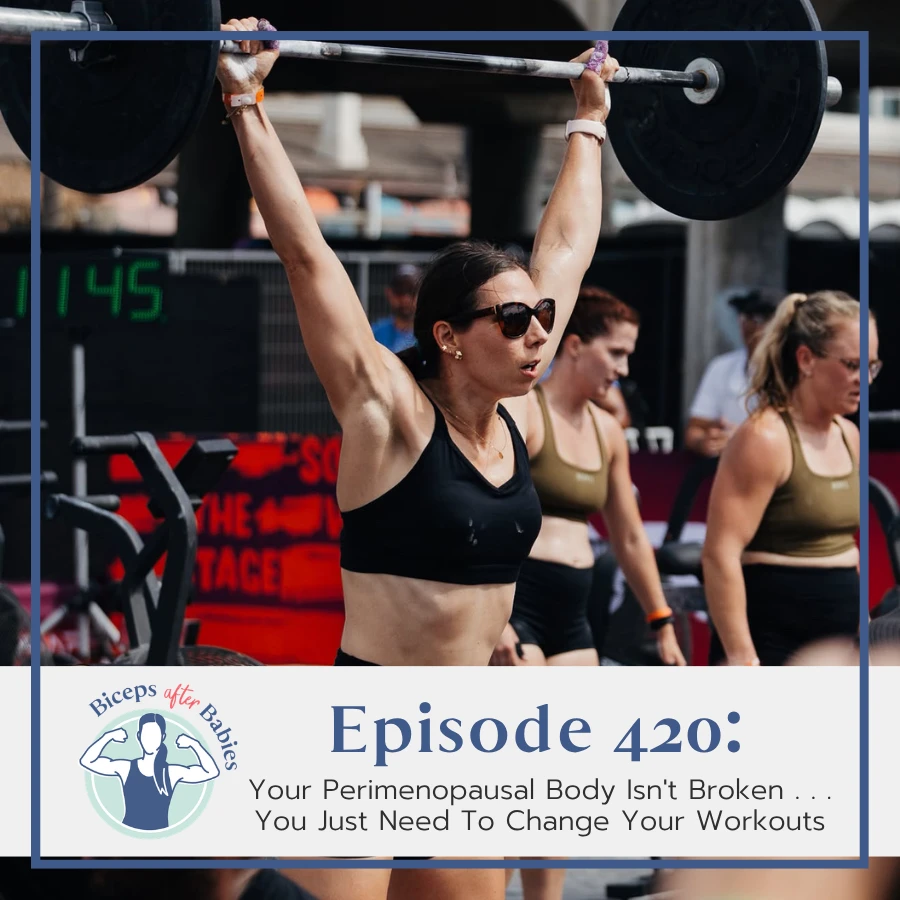
Show Notes
Does it ever feel like you're staring down perimenopause like a gun that's about to go off? There's so much fear on social media about what's coming for our bodies in midlife, and a lot of that fear comes from not really understanding what's happening. So today we're lifting up the covers and looking under the bed together, because your body isn't broken. It's changing, and when you understand the change, you can work with your body instead of fighting it.
This episode is a little different because I'm the one in the hot seat! My friend Monica Packer, host of the About Progress podcast, interviewed me for her More for Moms Conference, and she was kind enough to let me share the conversation here on my feed. We start with what's actually happening hormonally in perimenopause, including the shift from estradiol (E2) to E1, why estrogen acts like a “traffic controller” for where your body stores fat, and the three big drivers behind the midsection weight gain so many women notice: more hunger, less insulin sensitivity, and rising FSH.
From there we talk about the difference between acceptance and resignation. You can't control the fact that your body will go through menopause, but you can control what you do in the gym. Estrogen helps you build muscle and recover, so as it declines both get harder. Harder doesn't mean impossible, though! The best time to build muscle was yesterday, and the next best time is today. I also explain why muscle, not just more cardio, is one of your best tools for managing perimenopausal weight gain: it acts like a sponge for blood glucose and gives you a buffer against insulin resistance.
Then we get practical. We cover two to three full-body strength sessions a week built on compound lifts, why your sets have to actually be hard (and the difference between that burning fatigue and true mechanical failure), where beginners should start, and the sleep, stress and calorie levers that help you recover. We also dig into cardio: what zone two really is (hello, talk test), why HIIT and cortisol aren't the boogeyman the internet makes them out to be, and how to stair-step it all in so it fits your real life.
If you only remember one thing, make it my minimum effective dose: two 30-minute full-body lifting sessions, one short HIIT session, and one 30-minute zone two session a week. That's about an hour and 40 minutes total, and it's both your starting point and your fallback for the crazy seasons. And stick around to the end to hear what I'm seeking more of in my own life right now (spoiler: deeper friendships), plus a little challenge for you this week.
Highlights:
05:54 What's actually happening to your hormones in perimenopause
15:55 Acceptance vs. resignation, and why building muscle matters so much
21:26 Why muscle beats more cardio for perimenopausal weight gain
22:58 Recovery levers, plus how to set up your strength training
27:15 Lifting hard enough: mechanical failure vs. fatigue
33:07 Where beginners should start: movement patterns first
36:42 Zone two, HIIT and the truth about cortisol
45:30 The minimum effective dose workout plan
51:42 What I'm seeking more of right now
Want to know why your current workouts aren't giving you the results you want? Grab my free workshop, Why Your Workouts Aren't Working, at bicepsafterbabies.com/workshop. If you go through it, you'll get a discount on Build Your Workouts, where I teach you how to build a workout plan customized to your goals, schedule and equipment.
Introduction
You're listening to Biceps After Babies Radio episode 420.
Hello and welcome to Biceps After Babies Radio, a podcast for ladies who know that fitness is about so much more than pounds lost or PRs. It's about feeling confident in your skin and empowered in your life. I'm your host, Amber Briziky, a registered nurse, personal trainer, wife, and mom of four. Each week, my guests and I will excite and motivate you to take action in your own personal fitness as we talk about nutrition, exercise, mindset, personal development, and executing life with conscious intention. If your goal is to look, feel, and be strong and experience transformation from the inside out, you, my friend, are in the right place. Thank you for tuning in. Now let's jump into today's episode. Hey, hey, hey, welcome back to another episode of Biceps After Babies Radio. I'm your host, Amber Briziky, and today's episode is just a little bit different because this time I'm the one being interviewed. I'm the one in the hot seat. So this past fall, I was a speaker at the Moore for Moms conference that was put on by my friend Monica Packer. She runs an amazing podcast called About Progress. I've been interviewed on there a couple of times. And she reached out to me and wanted to do an episode about perimenopause and exercise. And I get asked questions about these two things in conjunction with one another all the time. So I was super excited to say yes. And the interview went fantastic. I feel like it was really comprehensive and shared a lot of information. And so I reached out to Monica after the conference and I said, Pretty, pretty please, can I have the audio so that I can air this on my podcast? And because she's amazing, she said, absolutely, here's the audio. And I'm really excited for you to hear this interview. Now, can I be honest? I am not currently perimenopausal myself. I am 42, so I'm definitely knocking on the door of perimenopause, but I'm not quite there yet. But I am in the age bradicate where I'm thinking about it. A lot of my friends are going through perimenopause. And I do think that there, while there's more education and more knowledge and understanding about perimenopause thanks to social media and thanks to just us being more open talking about natural hormonal changes in women, I think there's still a lot of fear about perimenopause because with the more education has also, and more people talking about it, has also come more people sharing things that are awful and scary. And I think it can feel like you're staring down the barrel of a gun that's about to go off. But I really think a lot of the fear comes from not really understanding what's happening to your body. When your kid thinks that there's a boogeyman under the bed, what do you do to help them feel less afraid? You lift the covers up and you look under the bed with them and you say, see, there's no boogeyman under here. It's a lot less scary once you see what's actually there. And that's what I really wanted to do in this episode today. I want to look at perimenopause. I want to help you understand what is actually happening hormonally to your body and how things are changing and shifting, not from a fear-mongering or you have to, this is gonna be a terrible experience of your life, but from understanding that this is a natural process that all women go through. And so in this episode, we cover what's going on with your hormones, why cardio isn't the main answer for any perimenopausal weight gain that you're seeing, and why panic about cortisol and HIT is a little bit overblown, in my opinion. Now, if you're in your 30s or in your 20s and you're like, well, this is obviously not for me, stick around. Absolutely the best way to be able to prepare and make it through menopause as unscathed as possible is to start preparing your body years and years and decades ahead of time. And so I'll get into that of things that you can be doing if you are in your 20s or your 30s or your 40s and you haven't hit perimenopause yet. Great. This is the time that you can start being making some changes that can really help you make that transition a lot easier. And then at the end of the episode, I give my minimum effective dose when it comes to workouts during this time frame. And, you know, a little spoiler, it's about an hour and 40 minutes a week. Okay. So you do not have to spend hours and hours and hours and hours in the gym to really help support your body through this transition and beyond into you know post-menopausal time as well. All right, that's enough chit-chatting.
Monica Packer 04:35
Let's get into the interview. Amber Brizicke, welcome back to the More for Moms Conference. Hey, Monica. I'm so excited to be here. You were like by far one of our most popular speakers last year, if not the most popular. I mean, such practical wisdom that you had in store for us that we had to have you back to talk about something everybody and their dog is talking about. To talk about everybody, every menopause.
Amber B 05:00
Well, good. I I really one of the things that I love is being a teacher. Like that is just like an identity that I really hold to. And so I love hearing that people found value from what I gave last year. And I think this is going to be a really hot topic this year.
Monica Packer 05:12
Oh, yeah, very hot topic. I mean, I feel like I'm talking about it all the time in my personal life, but even my professional life. And, you know, we're all things perimenopause around here, which is a word I didn't even know until maybe a year and a half ago. And now it's all I think about because I'm personally already going through it myself as an almost 40-year-old. But the thing I think we don't talk about with perimenopause is how it shifts the way you need to exercise. So we're going to get to that. Yes. But first, let's backtrack a bit for people who they've been, it's in in the zeitgeist, they're hearing the word, they know people are experiencing it, they know they should be aware of it, but they're also not fully in the know. Can you paint the picture of what's happening hormonally in perimenopause? And then we'll get to how that affects our exercise.
Amber B 05:54
Yes. And I think that this is such an important conversation to have because I don't know about you, but I mean, I'm in the same age bracket as you, right? And I feel like I'm staring down a gun that is like gonna go off. There's like a lot of fear that comes up so much with perimenopause in social media. And I think the more that we understand something, the less we just fear it because we can wrap our brain around it. And so I think it's really important. I think people think that they know what perimenopause is, but I think when you dig into it, they have a very superficial understanding of it. And I think the deeper our understanding, the more we can approach this with curiosity and compassion for ourselves and understanding of what's going on in our body. Because listen, your body isn't broken. It is, it's just changing. And yes, change can be scary and yes, change can be hard. But the more that you can understand the changes that are happening, the more we can work with our body and not against our body. And I feel like that's where a lot of people go into this middle age and they just feel like they're fighting their body. And that is never going to be a productive experience. And so if we can really understand what's happening inside of our body and that it's normal and it's natural, and every woman has gone through this since the age of time, then we can figure out what is going to work with our body during this time period. So menopause is a very defined period of time. It's actually defined as the final menstrual period. So the final menstrual period a woman ever has is the designation of menopause. Now we can only know this retroactively, right? Because you don't know when your last period, like you're like, I don't know if I'm gonna have another period. So we can only know it retroactively. So the way we've defined it is 12 months after your last period. So if you go a 12-month period of time, we can look back and we can say, oh, I hit menopause a year ago. Yes. The time before menopause is called perimenopause. And this is when you start to notice menstrual cycle disruptions, other hormonal fluctuations, and this can last several years. The average age for menopause is 51, but you can be as young as 40 or as old as 58. And then there's, you know, there's other people who are even younger than that. But that's kind of the age range that we're looking at. And so perimenopause is anything leading up to that time period, and you start to notice changes with your body. Or maybe you don't. I think that's important to know as well. It's like not everybody experiences the symptoms the same way. And that's one of the hard parts about the experience is it's it's a little different for everybody. So, what's happening hormonally? I'm not gonna get like super deep in the science, but I do think the science, understanding a little bit of the science is really helpful in wrapping your head around why these changes are happening, and more importantly, what you can do in the face of these changes. So, as a woman, once we start menstruating, every month your ovaries release estrogen. And what that does is it thickens the uterine lining. You can think about it like fertilizer, like it's the fertilizer for your u for your uterus. Okay, so we're we're preparing for an egg to be embedded. So your ovaries release estrogen, and then the egg follicle bursts, you release an egg, and now those ovaries release more or produce more progesterone. This is kind of like the lawn mower. It's gonna mow the lawn if you don't get pregnant. So that happens on a cycle every month during all of menstruation. During menopause, or once we hit that perimenopausal time, your eggs stop releasing or your ovaries stop releasing eggs with such consistency. Okay. So what we're happening is ovaries are releasing estrogen, but because there's no egg release, you're not releasing progesterone. And what happens is this leads to an estrogen dominance. Yes. So we have to start with an estrogen dominance. Um now estrogen is a lot of times people say like estrogen, like it's one thing. It's not, it's it's a family of hormones. There's E1, E2, and E3. And usually when people are talking about this broad like idea of estrogen, they're talking about E2, which is actually known as estradiol. But so before menopause, estradiol is very dominant. Okay, this is what our ovaries are releasing. And it's after menopause, when the ovaries start to shut down and we stop releasing eggs, we don't have any more eggs left. E2 plummets. So estradiol plummets. And this is what people talk about when they say with menopause, your estrogen goes down. They're talking specifically about E2. But it's not quite accurate to like label it that way because actually E1 uh actually now becomes the dominant estrogen. It's just a different type of estrogen. Okay. And so the the body now has to rely on E1 as the dominant estrogen of the body. So E2 goes down and A1 comes up. Why does this matter? Why does understanding this matter? Because all of the symptoms that people start to experience during perimenopause and menopause relate to E2 going down. Okay. The uh hot flashes, the brain fog, the anxiety, the depression, the headaches, the migraine. You know, 50% of women have sleep issues like night sweats or racing thoughts, the vaginal pain, the vaginal dryness, fatigue, digestive issues, joint pain, uh erratic mood moods, all of these are lead are linked to the decrease of estradiol going down. And then we get to the thing that most women complain the most about, which is the weight gain. That's uh one of the biggest things that women are coming to me complaining about. But the average weight gain during perimenopause is around five to eight pounds. And what happens, and what most women start to even see beyond that is weight redistribution. So what happens is your body starts distributing fat to your midsection and visceral fat. One of the things that estrogen does, it's kind of like a traffic controller. It like tells your body where to put fat. Pre-menopause, you have estrogen at, you know, E2 that is high, and it's basically shuttling fat more to the hips and thighs. You know, we a lot of women have a more of a pear shape than men do. Men have a more of an apple shape. Women have pear shape, and that's related to estrogen shunting any fat deposition into the thighs and hips. Well, when estrogen drops, we lose our traffic guide, right? Our traffic controller goes away. And so more of that fat gets shunned into the abdomen. And that's what a lot of women start to notice is they notice more of that abdominal fat, more visceral fat that happens. And this happens for a couple of reasons. One is I increase hunger. So estrogen regulates appetite. It runs on the same pathways as leptin, which is your hunger hormone that makes you feel satiated. So leptin can turn on these pathways, estrogen can turn on these pathways. When estrogen decreases, you now have like one of the keys that's gone to turn on the satiation pathway. And so women tend to have more cravings, they tend to be more hungry, less satiety, which causes you to eat more. So a lot of times women, as they're going through peri-menopause, are like, I haven't changed anything, anything. And I'm I'm seeing this weight gain. But oftentimes, if you're, especially if you're not tracking or you're not paying attention to it, you are eating more because you're more hungry, and that can lead to weight gain. Uh, another big thing is decreased insulin sensitivity. So as you decrease estrogen, it decreases your sensitivity to insulin. So what happens is you tend to have a higher blood sugar, you have some insulin resistance, and that's going to increase your fat storage in the in the cells and in the liver. And then the third thing that's driving that weight gain is increased FSH, so follicle stimulating hormone, which is going to stimulate the formation of fat cells and also slows down your metabolism. So it's kind of like a double, double whammy. So again, I don't say any of this to scare people or to say that this is something you should fear. But I think again, when we can understand the mechanism, we can say, okay, this is gonna happen to my body. This or this is happening to my body, or this happened to my body. Yeah. Now, how can I work with my body to be able to do the things that I want to do, to have the health that I want to health, to have the longevity that I want to have. And I really think where this comes down to is what's within our control. Yes. What can we control? Okay, and how can we focus on that? Because you can't control the fact that you're going through menopause. It is a natural biological process. You're going to go through it as a woman. So being scared about it isn't going to help you. Being educated and knowledgeable about it is, and then focusing on the things that you can control within that time period is going to make you feel so much more empowered and successful as you go through and navigate this very normal, natural stage of a woman's life.
Monica Packer 14:36
Okay, not only did I learn so much more than I even thought I needed to learn, like I thought I knew a lot. So thank you. Yeah. Two, this is really validating because I think a lot of what we experience that that war with our own bodies is because we are blaming ourselves for these changes and in ways that we're like, we're this is not our fault. Like you said, our our bodies are just changing. Um but then it also speaks to this other fear I think women have that if I expect this to happen and I accept that it's happening, then that means I'm just supposed to not do anything about it. And one thing that my audience knows I try to teach is acceptance does not equate apathy. And you just talked about that. We have to learn how to control what we can control. So I want to speak to that with working out more specifically, because all of those changes you just listed, they're about our body, and exercise is for our body and to support our body. So what are we forgetting to translate to working out in terms of expectations we hold about what working out is for as well as the outcomes that are appropriate for us to aim for? And so how does everything that know that we just learned shape how we should be seeing exercise and the point of it too?
Amber B 15:55
That's a good question. And I do think like the way that I describe it to my clients is there's a difference between acceptance and resonance resignation. I think that those are two totally different things. Acceptance means I don't spend time on the things that are outside of my control. I accept that this is what's happening and I'm not trying to fight it. Resignation means there's nothing I can do about this. Those are very, very different situations. You cannot, I mean, obviously, there's like HRT and there's hormone therapy and stuff. And I am a big proponent of having these conversations with your physician. If your physician doesn't want to have these conversations, finding someone who does, because obviously there are a lot of things that we can do in the medical realm in terms of hormone replacement. Uh, and obviously that's a conversation to have with your physician. But on some level, like there are things that we cannot change. Your body is going to go through menopause and trying to fight it and pretend like it's not happening isn't gonna do anything. So we can accept that it is happening. We can understand it. I think that's a piece that I what I'm really hoping women walk away from this conversation with is like it's gonna happen. And when you understand it, again, the fear of it decreases. Like the boogeyman that you like, you know, your kids think there's a boogeyman under the bed. What do you do? Well, you lift up the covers and you look. Like, like look at it. And then it's like, okay, it's not so scary because we like see what it actually is. So I hope that people feel a little bit more empowered to understand this process so they don't have to fear it so much. But yes, we can control the things that we can control. And obviously, there's a lot of symptoms. The symptoms for perimenopause are long and they're getting longer. I feel like we used to be like, yeah, hot flashes. That flashes, that's like the one symptom, right? That like my mom would talk about. But we are finding more and more and more symptoms that women are reporting that are we're linking back to menopause. So the the list of symptoms is long and it's getting longer. Obviously, I can't speak to every single single symptom. Sure. But what I do want to speak to is something that is within our control, and that is the exercise piece, the movement piece, the physical physicality piece. Going back to that conversation about estrogen, before perimenopause, estrogen is very helpful in building muscle. It actively supports muscle protein synthesis, it reduces muscle inflammation and damage after training, it improves your recovery between your sessions, it enhances the anabolic response. So basically, your muscles are actually responding to the resistance training. Okay. All of this to say use that as much as you can before merimenopause. Obviously, like you're listening to this at whatever age you're at and at whatever stage of life you're at, and you can't go back. None of us can go back in time. But if you're listening to this and you're a little bit earlier in the stage or you're you're in your 30s and kind of looking forward, one of the best things that you can be doing right now is building the most amount of muscle. Because as we enter periomenopause and as estrogen decreases, it becomes harder to build muscle. Not impossible. Absolutely not impossible. Still is very possible to build muscle within this time period. Research backs that up. However, it would be silly to say that it's not easier to build it the younger you are. And so if we can build a reservoir of muscle earlier in life and enter perimenopause and menopause and postmenopause with more muscle, as that estrogen decreases, as our body is less responsive to building muscle, we already have a reservoir. As muscle mass decreases naturally, as we age, again, we we are entering that period of time with a reservoir of muscle. So if you're in your 20s, your 30s, your early 40s, one of the best things that you can be doing right now is building as much muscle mass as possible. Okay, but what if you're not in your 20s or 30s or 40s and you're like, oh my gosh, I missed the window. You didn't. You did not miss the window. Okay. It being easier when you're younger does not mean it is not possible now. The best time to build muscle was yesterday. The next best time is right now. But there's a lot of research that supports the women who navigate perimenopause the the best are the ones who enter with the most muscle and or are focusing on building muscle right now. Okay. So that is one of the best things that you can be doing with your body is resistance training. And we can talk about cardio as well, because I think cardio has its place. Absolutely has its place. And we can talk about what that can look like during this period of time. But if there's one message I want to get out to women, it's that building muscle is going to help you through this period of time. And if you're not building muscle right now or you're not lifting weights right now, what an awesome opportunity. And you have so much excitement ahead of you to be able to do something that is really great for your body, is really great for your mental health, and is really great for your longevity. So building muscle. And we can talk about exactly what that looks like, but I want to make sure we cover what you want to cover.
Monica Packer 20:46
Yes, yes. Well, I mean, I I could definitely keep you here for like at least five hours and talk about everything. But, you know, I think where we're at right here is really good because we're we're not understanding better what's going on in the body. And now we're seeing how this impacts exercise specifically. Recovery is going to be harder for starters, which is something didn't know. Um building the muscle is going to be harder. Your muscle's responsiveness to what you're actually doing is going to be trickier. And so now you're leading us to some guideposts that because we understand better what's going on and also how it affects the way we we're working out. Maybe does that mean we're a little sore more often, or it just is just harder to build muscle in general, is what I'm hearing from you.
Amber B 21:26
Okay. Great question. So, okay, so I do want to make one point before we move into like actionable items of exactly what this looks like. And that is the piece around weight gain. So I had this, we had this conversation about weight gain, right? Estrogen goes down, we store more fat in our midsection. Most women gain weight during perimenopause. That is a real concern for a lot of women. And the way that most women think to fight it is the tool that they've used for a very long time, which is cardio, right? This idea that, like, oh, I'm gaining weight. I need to increase my cardio. I need to increase my caloric expenditure. Understand that line of thought. But what I want to help women to understand. Is that muscle mass is one of the best things that you can do in terms of weight gain during perimenopause. And here's why: it is because it's two things. One, muscle is a very metabolically active tissue, meaning it burns more calories all the time, right? My muscles are burning way more calories all the time, no matter what I am doing, versus any fat that is stored. So it's a very metabolically active tissue. But the second thing, and this is the thing that's really linked specifically to perimenopause, is that the more muscle mass you have, also the more glucose that muscle mass needs, which means your muscles become like a sponge for blood glucose. Okay. And if you remember what I said, what estrogen does is increases blood glucose. Okay, because it in it decreases our responsiveness to insulin. So we need a way to be able to manage blood glucose.
Monica Packer 22:57
Got it.
Amber B 22:58
One way that is amazing for managing blood glucose. So there's two things that I can give you that are specific, but one is building muscle, because muscle, it just it like will like slurp up the blood glucose because it needs that glucose inside of the muscle tissue itself. Okay. So the more muscle mass you have, the higher your metabolic floor, and the more buffer you have against this natural insulin resistance that tends to happen as we get older. That insulin resistance is what triggers visceral fat, it's what triggers that abdominal fat. So I get that people are like, I should do more cardio. But what I'm saying is muscle mass is actually going to help so much with that weight gain because it's gonna suck up that that blood glucose in a way that other other tissues don't. And that is is incredibly important. Okay, I'm so glad you differentiated that. Thank you. Okay. So then what so then what does this mean in terms of how do we actually do this? So I I mean, there are the realities of like, yes, you're gonna recover slower. It's gonna be a little bit harder. I see this in myself, and that's just a little bit about getting older as well. In my 20s and my 30s, anything that I could do in the gym, I could recover from. It was like not a thing. It was like, if I could do it, if I could physically was capable of doing it, I could recover from it. That is not the case now in my 40s. I can do more in the gym than I can recover from. So I've had to be really aware of recovery to make sure that I am allowing enough time, enough space, enough nutrients, enough calories to make sure, not enough sleep. If you want to talk about recovery, your recovery comes down to your sleep, your stress management, okay, and your calories. Okay. Unfortunately, because all three of those things are things that can feel hard to manage. But having enough nutrients, having enough calories, getting enough sleep, enough quality sleep specifically, and managing your stress in other areas of your body. Those are the three components that can help you boost up recovery. So it's not that you can't recover, it is more something you have to pay attention to as we enter peri- and post-menopause. But those are the three levers that you can uh pull for increased recovery. And then again, this is this is a little bit of the conversation of like, what can I control? What can I control? You can't control that decreased estrogen makes you less responsive to building muscle. Like that, like obviously HRT is a thing, and you're gonna talk about that with your physician, but you can't control that. What you can control is what you do in the gym. So what do I recommend? If you're listening to this with being like, okay, great, but what do I do with this? What is the what is the recommendations? The the biggest shift comes from implementing at least two to three full body resistance training sessions a week. Okay. That that across the board, you do that one thing, that is gonna make that's the biggest lever mover for you. Okay, two to three full body resistance training sessions per week. Now, I gotta caveat that a little bit because how you set this up matters. What are we doing in terms of lifts? Well, the research is really clear. Focusing on compound lifts is the biggest bang for your buck. So compound lifts just means that you are working more than one joint and more than one muscle group at a time. You think about a squat. A squat is involving hinging at the ankles, hinging at the knees, hinging at the hips. It's involving lots of muscle groups, right? You're involving the quads, the hamstrings, the glutes, the calves, the core. Even if you have a barbell on your back, the upper back is tight. So you're involving a lot, a lot of muscle groups all at once. These are the movements that we need to prioritize: squats, lunges. Sounds more efficient, too, which is kind of nice. Like more bang for your buck. You think about a leg extension machine and you're hitting the quads. Yeah. And that's you're hitting one muscle group, one joint. Uh-huh. Hit the knee joint. Okay. Or you can do squats and you can work the quads and the hamstrings and the glutes and the calves and the abs and the upper back all in one movement. So it is more efficient. Yes, which is why squats, lunges, deadlifts, push-ups, pull-ups, things that work multiple muscle groups at once are gonna be the the thing that you want to be focusing on. Okay. And then here's the thing that most people miss. And I and I I get why this feels it's it's hard. It's it's hard. Let's we'll just say this. It's hard. You have to lift heavy enough. Okay. You have like it has to be hard. If it's not hard, it's not doing anything. And I say that with like all the love in my heart, right? Like I want you to be able to get the results, but I see a lot of women going to the gym, I see a lot of women lifting weights, and they're getting nowhere near the point where it's actually challenging and it's actually hard. And if you do that, you're just spinning your wheels. Especially, it needs to be heavier, to be hard. And I'm not hurting to be heavy. I wouldn't even say it needs to be heavier. It just needs to get hard. Okay. Okay. The body of research that we have says rep anywhere from like three reps to 30 reps can be efficient at building muscle. What you have to do is you have to get to the point where it's challenging.
Monica Packer 28:16
Got it. Okay. So that's kind of a shift in what and some things I was hearing. Like it's only about you only lift heavy, but you're saying as long as it feels hard.
Amber B 28:25
Yes, you're gonna be able to do that. And what I look at what I look at with my clients is the speed. Okay. So if you've done a hard set, you know, let's I mean, let's even take like a bicep curl. If you're doing a bicep curl, those first ones, they move pretty fast. You start to get a little bit fatigued, they start to move a little bit slower. By the time you're getting to the end, a rep that took less than one second now may take a second and a half to like grind it out to like get to the top. That's where you're wanting to get to. You want the bar speed, the dumbbell, the whatever you're lifting, you want it to slow down because you're physically getting to that point where the muscle is not able to contract anymore. So whether that's at 30 reps or it's at three reps, it matters way less than that you're hitting that level of I, it's getting really hard, it's getting really challenging. Now, one caveat to that, I tend to like to work in a little lower rep range. And here's the reason there is a difference between fatigue accumulating and hitting mechanical failure, which is where the muscle can't contract. Mechanical failure is going to drive muscle mass. Fatigue isn't necessarily going to. And fatigue feels like the burning. Okay. Right. We've all experienced like I'm lifting something and it starts burning, it's uncomfortable. That's not what I'm talking about. That's not what you need to hit. You need to hit mechanical failure where you can't actually do it. That's why I like looking at speed of the rep more. So my the struggle with high reps is that you usually start to hit fatigue first. Yeah. Before you hit mechanical failure. And it can be hard for people to differentiate between the two. Because they're like, oh, it's burning. It's burning. It's burning. I feel it. I feel it. And it's like, yeah, but that's not it. Fatigue and mechanical failure aren't the same thing. And so for people, especially who are newer, I tend to like to bring those reps down a little bit. I don't really like to work in like the 20 to 30 rep range. I like to bring them down more. And like the 12 is a good number. That's a good place for most people because you have to go heavy enough and you tend to not hit fatigue and the burning sensation as much. But you're gonna hit that mechanical failure. Does that make sense that how I'm describing that, Monica?
Monica Packer 30:37
No, it does because I think like, oh, I could get like a five-pound weight and do a bicep curl and after, you know, 30 or 40, then I would feel really tired. But I could do like a 20-pound, I know that's probably not very much to you, but I could do like a 20-pound weight and then like after 10 physically not even be able to lift it. Right. I know that's hurting me, but I literally can't. So that's exactly that helps paint the picture for me about where I'm kind of going wrong with some of this stuff.
Amber B 31:06
And that's what we call failure. So if you talk, hear people talk about going to failure. Failure is when like you couldn't pay me $10,000 to do another rep. Yeah. Like, like I just I physically cannot contract my muscles to do another rep. So then the question becomes well, how close do you need to get to failure? Do you always have to train to failure? The answer is no. The research is really clear. As long as you're training within one to two reps of failure, you're getting, you're getting good stimulus for the muscle growth. The problem is that a lot of people think they're within one to two reps of failure. And they're more like five to six reps of failure because they don't know what failure is. They've never experienced. And so I do think it's helpful as you're as you're learning, as you're growing in the gym, go all the way to failure. Right. And I let's start with like a bicep curl is a great one to take to failure way before a squat. Is a great one to Right. So, like, let's start with like smaller muscle grooves. I'm not saying have to sit on the floor mid-squat at the gym. Like the debt to failure, right? Like that's what I'm talking about. But feeling what it feels like so that you know, oh, that like most people, you can do way more than you think you can. And if you've never gone to failure, you don't actually know where failure is. Once you've gone there, you can gauge a little bit more of like how slow the bar comes up or the dumbbell comes up, and you can kind of gauge it. But as long as you're within one to two reps of failure, that's enough to stimulate muscle growth. But if you're too far away from it, you're there's there's nothing happening, especially in periomenopause when we don't have the estrogen to support muscle growth like we did when we were younger.
Monica Packer 32:38
Well, and again, it's going to that efficiency piece to it. We can work out for the same amount of time, but in a way that's more efficient by doing one of those compound exercises you said and working to fatigue. But I also like that you just mentioned you can work up to it. Like you don't have to do this for every single movement for every single workout starting tomorrow. You can just try it out with one movement until you understand it better and then work up to another or work up to other weights too as you go.
Amber B 33:07
Yeah, and I would never suggest a beginner go to failure. I would never suggest a beginner is like loading up heavy weights. A beginner's job. So if you're listening to this and you don't have experience lifting and you're just a total beginner and you're like, oh my gosh, I want to start resistance training because I see how beneficial it is for my body. I see how healthy it is. Okay, I'm gonna do this thing. It's probably a little scary to you. I totally understand. Your job is movement patterns, not weight. Okay, so getting the right. It's the form. I want you to inform. Well, I want you to get movement patterns. So, like a squat is a movement pattern. You're gonna squat the rest of your life, whether you have a barbell on your back or not, right? You're gonna squat to pick up your kids, you're gonna squat to pick up the groceries, you're gonna squat. Like we squatting is a movement pattern that we do all the time. It's a functional movement pattern. So I want you to get a good functional movement pattern of a squat. And because we are using so many joints and muscles, it you can feel a little bit like a baby deer. Like you don't really know where your body is in space. You kind of like lean forward too much, you round your back too much, right? Like it, those are all that's all very normal. So I want you to get the movement pattern and feel comfortable with the movement pattern without any weight at all before we start adding slowly weight. So, my beginners, I'll have you start with a body weight squat. I will have you start with an elevated push-up. Maybe we're doing push-ups on the wall, or we're putting our hands on a table and we're doing a push-up there. So we can modify the movement so it's a little, you're still getting that compound lift, but we're learning movement patterns. Same thing with the deadlift. Like we can deadlift with a broomstick, we can lunge with the body weight. So that's uh that is where I want beginners to start is with movement patterns, feeling confident, being able to move your own body weight first, and then we can start to conservatively add weight. So you're gonna go from body weight to five pounds, to 10 pounds, to 15 pounds, to 20 pounds, right? Well, you're I never want clients to jump in huge weights, especially if you're new and a beginner. You're just slowly allowing your body to adapt and get a little stronger and get a little stronger and get a little stronger and get a little stronger, and you will be shocked where you can be as a beginner, and then six months later with your squat or your deadlift or any of these things.
Monica Packer 35:27
Okay. And this is where, you know, our conversation in last year's conference was so helpful with this because um we were talking about the ideals, but you gave us a wonderful way to begin. And that the only point is just moving. If you can just move for now, great, then you can build up to it. And also, I like having these guideposts for this very challenging time that we have to accept that's going to happen, whether we like it or not. I'm gonna recap some and then if you want to add to it or expand on any of these, that's great. I just want to refresh where we're at. So, some guideposts as we are working through exercise as as we're going through parametrause. Wanted to really prioritize resistance training. And you said two to three full body resistance training uh sessions per week. Try to focus on compound lists, lifts, and working to mechanical failure. So that's what I've got so far. And the second big guidepost category I have is recovery. And you gave three ways to do that. One is making sure we're eating, having nutrition that helps us recover, sleeping to help recover, and stressing less to recover. So that's what I've got so far, Amber. Yes. What am I missing? What do we need to add to these guys? Okay.
Amber B 36:36
The last piece that I would love to add is cardio. Okay. Talk a little bit about cardio.
Monica Packer 36:41
Yeah.
Amber B 36:42
Okay. Because I think there's a lot of fear-mongering that comes around with cardio, a lot of misunderstanding when that comes around cardio. Again, if I could have anybody listening do one thing differently, it would be resistance training. Okay. So start that's the first thing, right? Start there. Okay. If you're not doing resistance training, that is the first thing. But if you're already doing your resistance training and that's already a part of your plan and you're like, okay, I want to know the next step, the next thing that I can be adding and working on, it would be cardio. There is a lot of discourse in the space about the different forms of cardio, and specifically when it comes to perimenopause, which ones are best. Okay. Because of the stress factor. Is that exactly that's the thing that people point to. Okay. This is a nuanced conversation and we're going to have it. Okay. So we first have to understand that the way that we categorize cardio is usually according to heart rate. Okay. So we have a heart rate max, and then we base our cardios off of the zones comparable to that heart rate max. So we have like a zone one, we have a zone two, a zone three, a zone four, zone five. Basically, we're working up in percentages: 50 to 60%, 60 to 70%, 70 to 80, 80 to 90, 90 to 100. Those are the zones that we talk about when it comes to heart rate. So there is a camp or a type, I should say, a style of cardio that has it used to be called LIS, low intensity, steady state cardio. It has since been rebranded to zone two. You'll hear it more as zone two these days, but it back in the day, it just used to be called LIS. Zone two is working, you know, between that 60 to 70 percent of your heart rate max. Okay. Um, and it is a longer session. Usually we're talking 30 to 60 minutes. And most people don't know their heart rate, they don't know their heart rate max. That's totally fine. You don't have to know that. I like to use what I call the talk test with my clients. Oh, yeah. So the talk test means you are in zone two. If you can have a conversation in full sentences, but it sounds breathy. Okay. So when you're sitting there chatting and just having this amazing conversation with your friend while you're walking, you're probably not in zone two. It should sound a little breathy. Like I can say a sentence, but like you can tell I'm doing something. It's it's not it's not easy. Okay. So that is zone two. When we move up into where you have to take breaths in the middle of sentences, so that would be like, Monica, I really love your dress today. It looks really nice. Right. We've probably moved up into a zone three. Okay. So that's a really great guide. So zone two. Zone two is really great at increasing the number of mitochondria in our muscle cells and the capacity of those mitochondria. If you remember back to your biochemia. I'm going way back. Yeah. Mitochondria is the power of this house of the cell and it it creates energy. And so zone two really drives the number of mitochondria and the efficiency of those mitochondria to be able to generate sustained energy. Efficiency again. Yep. Okay. Efficiency again. That's the name of the game. Okay, so that's your zone two. Okay. So then we have our zone like four and five. And this is usually known as hit, high intensity interval training, or sit, sprint interval training. HIT is more in that like zone four-ish, where we're doing a push and then a recovery and then a push and recovery. So your heart rate's spiking, it's recovering. It's spiking, it's recovering. Sit is a subset of HIT and it is a all-out sprint. So it is a like empty the tank. Everything you have. I'm running from a lion. Recover. Running from a lion, recover. That's that's sit. Okay. Okay. So then there's this is the discourse online. People are like perimenopause is a stress on your body. A lot of women are stressed out. Doing zone four or five, doing hit, doing sit spikes your cortisol. So that's bad. And we don't want to do that. Okay. It's so much more nuanced than that. What you have to understand is that cortisol is not a bad hormone. It is a hormone your body produces to deal with stress. To say, hey, we're under a stressful event right now. We need to up our reservoir. We need to make sure we can handle this stress and we need to arm the body for this stress so that we can get through it and get to the other side. So it's helping. It's trying to help. It is trying to help. It is trying to help. It's the way that our body deals with stress. Exercise is stress. It has to be. If it's going to do anything, it has to stress your body. So cortisol rising during a stressful event is very adaptive. It is a good thing for us to do. Acute cortisol spikes are not a problem. The problem is chronic cortisol. Okay. Chronic stress. Yeah. Okay. That is the problem. That's maladaptive. Yes, that is maladaptive. And that's what we're experiencing a lot in our society is chronic stress because we don't sleep enough. We don't eat enough. We don't recover enough. We don't do stress management. We take on way too much, right? Like, but that has nothing to do with your workouts. Right. That is that's a different ballgame. Uh-huh. So yeah, if you are chronically stressed, maybe adding the extra stress of something like HIT, I mean oh, maybe for you in this season of time, it's it is not helpful. But that is a very different conversation that you have individually than on a broad, what we recommend broadly, because the research really supports it. HIT during menopause is the best way to lose fat. That's the research, like the research is very clear. There's a great meta-analysis that was done in 2020 that did analysis of all the research that we had, the body of research for peri and postmenopausal women. And they looked at HIT and different styles of HIT and how that helped. And it was really clear, especially for the perimenopausal, this the evidence didn't come out as strong for postmenopausal. But for the perimenopausal women, HIT decreased fat mass, decreased visceral mass was the best way to be able to manage the fat gain that women were having was HIT. It is an interesting conversation. There's a lot of nuance to this that I think gets lost when we start to have these conversations online and when you just see a blank statements. Yeah, that like scare women. But I just I like I think this the boogeyman of like cortisol is is misplaced. Cortisol rises when you like that's why you wake up in the morning because your cortisol spikes. Like it is a normal, natural hormone that we don't have to be afraid of and that we can't get rid of. We don't want to get rid of it. But what we want to do is manage our chronic stress. That goes back to that recovery piece. And so do you have things in place to manage your chronic stress? Are you sleeping enough? Are you eating enough calories? Because a lot of women aren't. Is your food diversity good? Are you getting the micronutrients you need? Rather than making HIT the boogeyman, let's focus on those aspects first. Um, because HIT can be very, very good at improving insulin sensitivity, at uh getting an afterburn effect. Again, it helps those muscles like soak up the blood glucose that we have. And so it's it's a fantastic thing to add. So, what are my recommendations? One to two days of HIT a week. And I would add that first, and then Again, I know, I know it starts to become a lot. So I say this with the caveat of like stair step it, right? Start with the resistance training. You got that and that's easy and you're good at that. Let's add the hit. Okay. It can be at the end of your lifting sessions. And then after that is at zone two. Two to three days a week, 30 to 60 minutes a time. I know we're getting a lot of like time. So again, I recognize that we have to fit this within the confines of your actual life. But zone two is really beneficial as well. And that would be what a well-rounded system would look like. Okay.
Monica Packer 44:32
Yeah. I I think the thing that I keep coming back to one is the efficiency piece and that we can be more efficient with our workouts and we're thinking, meaning it takes less time. Yes. Which is helpful with some of these guideposts that you gave us. But two, that variety matters. Yes. Um, and I love the stair-stepping approach with this because I think it's really important that recovery is coming even before cardio. Because, like you said, the s the biggest source of our stress is like our day-to-day lives, not what we're doing in our exercise. So that's exactly right. I mean, we could spend many more hours on just that piece alone, but gosh, is can I just give a minimal effective dose? Because I'm not sure. I know I was just going to ask. Like for the person who is who maybe they have been exercising, but maybe they've only been walking, or they've only been doing strength training, or they've only been doing HIT, and they're just ready to like have that variety piece in the more efficient way that we've been saying what's the the bare minimum that they should start with.
Amber B 45:30
If I was gonna build a minimum effectible dose plan, okay, it would be two days a week of full body lifting, anywhere from 20 to 30 minutes. Okay. Okay. With compound lifts and compound movements, you can get a great full body lift in within 30 minutes. Okay. Wow. So two days a week, 30 minutes, you're doing all compound lifts, you're doing all full body, full body movements. Okay. So that's the resistance training piece. And then for your cardio, one hit a week. Okay. And that can look like, you know, I I like the bike. That's kind of usually my preferred hit. So it's like a one minute on the bike, pedaling fast, getting that heart rate up, and then anywhere from like a one to a three minute recovery, depending on your fitness level. Great. And then you cycle that four to five to maybe six times. Again, we can build that up. But you can get hit done in like five minutes, or not five minutes, like maybe ten minutes. Right. Like most of my hit sessions, yeah. Oh yeah. That's why hit is so great, because it is, say it with me, efficient. Efficient. So yeah, you can get a great hit in in under 12 minutes for sure. So one hit session a week. Right. So we have so what do we have? A total of an hour of lifting. Okay. We have one per 10 minute per week, one 10-minute hit session. Okay. And then one zone two cardio where you're doing 30 minutes of getting up into that zone two. Okay. So now what do we at? Like an hour and 40 minutes for like your minimal effect dose. For an entire week. For an entire week, right? That's that is like that is gonna get you so much fitter, so much healthier. You're gonna start to reap all the benefits of benefits of the things that I'm talking about as you go through perimenopause. And then yeah, of course, I'd love to have you build up from there. And I'd love to have you like be able to add that, but I recognize people are busy and that is that you can get a lot of bang for your buck with what do we say, an hour and 40 minutes a week?
Monica Packer 47:20
Yeah. And and you know, you and I have talked many times over the years about exercise, nutrition, slash habit formation. And we all know the name of the game is consistency, and a lot of times our perfection costs us consistency. So this is where we start not only so that we can build from there, but that we have the consistency to build. So I think it's really important that you're giving us baseline ways to start on and also to fall back to when things just get crazy, like we we all are gonna have those seasons. Amber, you've done the delicate balance of teaching us in not only so much in such a short amount of time. Thank you for that. But also, like, you know, kind of giving us those kicks in the pants that we need, but all in a way that feels generous and grace-bound too, which is such a again, a delicate balance to strike. So thank you for all of this. I know people are gonna want to learn way, way more from you just based off this one conversation. Let's start with the freebie and bonus, and then we can talk more about socials before we end with our final question. I want to first point them to the freebie that everyone gets access to. Why your workouts aren't working? What is that? We'll just share that so they can know it's gonna be linked for you. But what is that? Why your workouts aren't working, freebie?
Amber B 48:32
Yeah, so this is a class that I put together to be able to help kind of put a lot of this stuff into one cohesive class. A lot of women I find are working out, but it's not actually producing the results they want. They don't see results in the mirror, they don't feel anything different, and they're like, I'm spending all this time doing this thing that I'm supposed to be doing, but why isn't it changing my body composition? Why am I not seeing muscle build? Why am I not seeing fat loss? And so I put together about a 60-minute presentation. It's really a workshop. You're gonna leave with an idea of like, okay, here's why my workouts aren't working and here's what I need to change to be able to make them more effective and more efficient. And so I walk through five different aspects that you need to be looking at. We talk about cardio, we talk about lifting, we talk about I making sure you know what your goals are and being able to work backwards from them. Um, and I help you to be able to look at your do a critical look of like what your workout plan is right now and how to make it better.
Monica Packer 49:26
Beautiful. I need that. I need that. So again, that's why your workouts aren't working. It'll be linked for you. And then one lucky winner will get this bonus, but everyone can go check it out. Build your workout. It's a self-guided, more of a built-up workshop than your class. Can you tell them more about that? Yeah.
Amber B 49:43
So build your workouts is a template-driven program where I help you take concepts and actually make a workout plan. Right. So it's like, okay, the theory is nice. Okay, but what do I do on Monday when I go to the gym? Right. So I want to bridge that gap and help you figure out how do you create a custom workout plan that fits your life, your schedule, the equipment that you have. And so I walk you through this decision tree and this decision making process and have templates that you can just plug in. So by the end of this program, you have, you know, exactly what you're doing Monday, Tuesday, Wednesday, Thursday, Friday. You know how many rest days you're doing, you know how many days of cardio, you know what kind of cardio you're doing, you know what kind of split you're doing, you know how many reps, how many sets. You program it all so that you have a workout plan that is customized for you and your body. And if you go through the workshop, I give a discount code as well. So if you want a little bit of money off, go through that workshop and there's a discount code linked for build your workouts. Awesome.
Monica Packer 50:44
So if you're not the lucky bonus winner, go take the why your workouts aren't working to get the discount to build your workout. And for those, um, again, that's all linked for you in the show notes, but those for those who want to learn more from you, you've got your podcast, your Instagram. Can you tell us directly where to go for those?
Amber B 51:00
Yeah. So Biceps After Babies Radio is my podcast. And I have over 400 episodes where I talk about training, I talk about nutrition, I talk about mindset, I talk about personal growth. And so if you like this kind of content, you're gonna love the podcast. And then I'm most active on Instagram under biceps after babies as well.
Monica Packer 51:20
Okay. Well, I mean, clearly I could keep talking D forever because I have for many years. And now I have all these other ideas with things I want to talk to you about. So definitely learn more from Amber. Make sure you sign up for that freebie at very least. I want to end with a final question that each speaker is sharing. And it is what is one way you are currently seeking for more out of your life?
Amber B 51:42
I love this question. And I think it, you know, definitely goes through you go through different phases of your life. And so the phase that I'm in right now is what I'm calling my depth phase. I am looking for connection, which I think a lot of women our age are looking for. It's like, how do you make friends as an adult? Seems to be like a question a lot of us are asking. Yeah. But I am not looking for like superficial. I'm looking to like go deep with a few people. And this has been a really fun focus for me because it's pushed me to go know myself a little bit more, go deep with myself to then be able to connect with somebody on a deeper level. So both my husband and I have really been working at how do we form those deep relationships where we actually know somebody, where we get beyond the pleasantries and we get beyond the like, hey, how's your day? And we actually understand like, what are you struggling with? What is hard for you? What are you working on? What are you really proud of? And have these deeper conversations. I have a couple of friends who are really great examples of people who do this really well. And it's and it's been such a joy to get to know them that I've I've tried to take some of those things I'm learning from these friends and apply it to other friendships. So I'm really looking to go deep on connection and I'm kind of ready to move past the superficial and I want to go deep with just a few people.
Monica Packer 53:00
That is such a beautiful answer. That is making me think about my own life. Wow, Amber, you are just the most amazing woman. And I so appreciate your generosity and what you shared today, and also your willingness to always teach women wherever they are. Thank you for being here.
Amber B 53:16
Oh, thanks for having me. I love talking about this stuff, and I hope that my goal is that you made it to the end of this and you feel more empowered to like walk through this period of time that can feel a little scary because it's unknown and it's different for everybody. But understand that it is normal, it is natural, it doesn't have to be weird. There's a lot of things that are within your control. And if you start today, like today is always the best day to start, right? I said that earlier. The best day to start was five years ago. And the next best day is always today. Okay, so if you only remember one thing from this episode, make it this. Two full body lifting sessions a week, about 30 minutes at least each, focused on compound lifts, one short hit session, and one 30-minute zone two session. That's it. That's your starting point. And it's your fallback for any crazy seasons that you're going through in your life as well. Now, if you want help figuring out why your current workouts aren't giving you the results you want, you can go to my free workshop, why your workouts aren't working at biceps afterbabies.com forward slash workshop. And if you go through it, you'll get a discount on my program, Build Your Workouts, where I actually teach you how to construct a really effective workout plan that's customized to you, to your goals, to the equipment that you have, the space that you have available. I want to help women actually see results. And when you are putting in time and effort into your workouts, I want to make sure that you're actually feeling and looking different. And that's what I teach you how to do in my workshop and also in Build Your Workouts. So you can go to bicepsafterbabies.com forward slash workshop to get started. Now, one more thing. At the end of the interview, Monica asked what I'm seeking more of right now. And my answer was depth, you know, fewer, deeper friendships where we actually know what each other is struggling with. So maybe text one friend this week and you know, skip the how's your day and ask her something real. Ask her what's really going on or share something that's hard for you or something real that you're going through and form that connection. I challenge you to make those friendships a little bit deeper yourself. All right, that wraps up this episode of Biceps After Babies Radio. Now go out and be strong because remember, my friend, you can do anything. Hold up, sister friend. Do you love Biceps After Babies Radio? If so, the best way to say thank you is to subscribe to the podcast and leave a review on iTunes. I know every podcaster wants you to leave a review, but it's because those reviews help the podcast to reach more people. And I do truly want to know what you think. If this particular episode resonated with you, will you also please share it? Either send the link to someone who would find it valuable or take a screenshot and post it to your social media and tell your friends and family why they should listen. Make sure you tag me at biceps.after.babies so I can hear your feedback and give you a little love. And you know, if you aren't already following me on Instagram or Facebook, that's the perfect time to hit that follow button. Thank you for being here and listening to Biceps After Babies Radio.
Outro
Hold up sister friend. Do you love Biceps After Babies Radio? If so, the best way to say thank you is to subscribe to the podcast and leave a review on iTunes. I know every podcaster wants you to leave a review, but it's because those reviews help the podcast to reach more people. And I do truly want to know what you think. If this particular episode resonated with you, will you also please share it? Either send the link to someone who would find it valuable or take a screenshot and post it to your social media and tell your friends and family why they should listen. Make sure you tag me at biceps.after.babies so I can hear your feedback and give you a little love. And you know, if you aren't already following me on Instagram or Facebook, that's the perfect time to hit that follow button. Thank you for being here and listening to Biceps After Babies Radio.

Leave a Reply