




Show Notes
Want to know the real reason I don’t share everything I’m trying on Instagram? It’s because the little tweaks always steal attention from the big rocks — and I don’t want you chasing a supplement before you’ve nailed the basics. But this is my podcast audience, and you already have the foundation down. So in this episode, I’m pulling back the curtain on every experiment I’ve run on my own body over the last several months, specifically around food, training, and sleep.
On the food side, I walk through my bulk earlier this year (2,250 up to 2,400 calories, gaining about six pounds over five months) and the mini-cut I started afterward, including the micronutrient tweaks I’ve been playing with — a 2:1 potassium-to-sodium ratio to manage water retention, and why I’m not afraid of sodium when I’m lifting.
On training, I share why I went back to three leg days a week after getting injured trying it last year, what changed this time around, and a mental trick I’ve been using — training to failure in just two hard sets instead of three or four — that’s let me push harder and add more exercise variety.
But the real headline here is sleep. I get into the specific changes that finally moved my deep sleep numbers after months of frustration: keeping my wake time consistent even on weekends (annoying, but it works), closing my eating window hours before bed, and the exact supplement stack — including which form of magnesium made the biggest difference — that took my deep sleep from 30-45 minutes a night to over an hour.
Highlights
- Why I don’t share all my experiments on Instagram 00:00
- My bulk and mini-cut numbers, plus the sodium/potassium trick for water retention 02:02
- Going back to three leg days a week without getting injured, and training to failure in two sets 09:05
- The sleep and recovery changes that finally moved the needle on my deep sleep 12:19
- My actual sleep data: before and after 17:56
Introduction
You’re listening to Biceps After Babies Radio episode 421. Hello and welcome to Biceps After Babies Radio, a podcast for ladies who know that fitness is about so much more than pounds lost or PR’s. It’s about feeling confident in your skin and empowered in your life. I’m your host Amber Brueseke, a registered nurse, personal trainer, wife and mom of four. Each week my guests and I will excite and motivate you to take action in your own personal fitness as we talk about nutrition, exercise, mindset, personal development and executing life with conscious intention. If your goal is to look, feel and be strong and experience transformation from the inside out, you my friend are in the right place. Thank you for tuning in. Now, let’s jump into today’s episode.
Amber 00:00
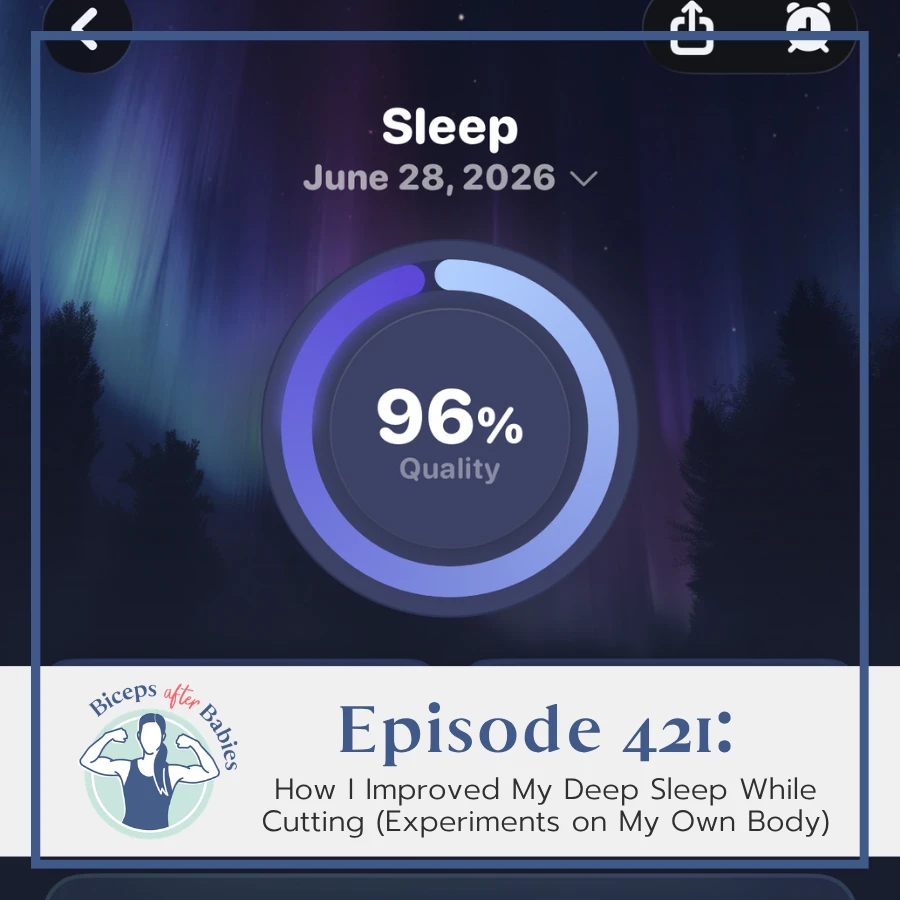
I did want to start out with just doing like a little bit of a recap with you guys on some of the things that I’m doing in my own journey. Sometimes I like to share some of this stuff on Instagram, but I don’t like to share all of it on Instagram. And I’ll tell you why. The reason I don’t like to share it all on Instagram is because when I share the things that I’m going to talk about, I’m going to share like the little tweaks I’m doing, right? The little experiments I’m running with myself, some of the supplements I’m trying, some of the, you know, new things I’m doing to optimize my nutrition and training and health. And sometimes when I talk about those things on Instagram, people like latch onto them and they think that that’s the secret sauce. And they miss like everything that is like the foundation of like what actually makes the change, which is, are you moving your body? Are you are you training consistently? Are you lifting weights? Are you eating well? Are you tracking your food? Are you tracking your data? Right. Like there’s so many of these like big rocks. And when I start talking about this stuff on social media, people just like zoom right in on it. And they’re like, that’s the answer. That’s the solution. And I just want to shake people and be like, oh my gosh, you have like so many big rocks that you need to take care of first before we get to talking about like the little nitty-gritty stuff. But this group, it’s a great group to be able to talk about this stuff with because you guys already understand the basics. You guys already understand the foundation. You understand tracking your food. You understand training. Like you understand that the things that I’m going to talk about are like the little cherries on top, the little, the little levers, right? We have big levers and we have little levers. And today I’m going to be talking about some of the little levers that I’ve done in my own journey, just as I I think it’d be fun. It’d be fun to talk about it. I do want to be clear in no way am I saying that you need to do any of these things or that these are magic secret secret things. They are experiments that I’ve been running own body, and I’m going to kind of wanted some of the things I’m seeing. So I made a very areas of focus for me, which are food, sleep and recovery, and training, and some of the different things that I’ve been doing in those different areas. So let’s first talk about food. I have mentioned this on Instagram that I started a bulk in the beginning of January. And just to like kind of talk a little bit about my mindset around this, of like, why am I doing this? Many of you know that last year I did a cut. I did like a six-week cut. A lot of you guys followed along on that six-week cut. And I was able to get fairly lean in that cut. And when I cut down, I realized what a lot of times we realize that like maybe I don’t quite have as much muscle as I thought I did. And so I was, I was really excited coming out of that cut saying, okay, I kind of have an idea now of how much muscle mass I have. And I really want to get jacked. Like I really, I really do. That sounds really fun to me. I was telling some of my friends this and they looked at me and they’re like, you are jacked. And I was like, just for like a normal person, but I like I’m not jacked for like a gym person. Like I in fact, when I went into my comp up in Northern California at the end of last month, oh my gosh, I’m walking around in like the athletes with all the athletes, and I’m like, I want people to see these people because this is what it looks like to be jacked. So anyway, being jacked sounded kind of fun to me. It sounded like a cool goal. And you know, I’m getting older and I feel like going into perimenopause with as much muscle mass as possible is a really good goal. So that was that was my reasons for starting this bulk in January of this last year. So my starting weight for my bulk was 140 pounds. I started at 2250 calories, and by the end, I’ve I increased up to 2400 calories. That was kind of my sweet spot. I was able to, I started a little bit conservative and then increased as I as I realized that I needed to based off of my data and my weight. And by the end, you know, by May, I was doing 2,400 calories a day. That was including five days of weightlifting, one day of hit, and one day of lists. Oh, that was my weekly training schedule. I will note that that hasn’t changed at all. Like that’s been my consistent the whole entire time. And so what are the stats? So over about the five months, so beginning of January to the end of May, I gained about six pounds, ending around 146. So you can see here’s my here’s my graph, all those dots, but you can see that line trending upward. And I felt really good about the speed at which we were going. I felt really good about the the pace, and everything was like pointing in the right direction. Muscle, I could see more muscle mass, lifts were getting stronger. It was all really good. At the very end of May was when I did my CrossFit competition. So that was also really fun, too, as well, as I was able to like titrate upwards into that CrossFit competition and be at a really peak weight and muscle mass to be able to compete in my in my CrossFit competition. So then I decided once I came back from my CrossFit competition, I was like, okay, let’s do a mini cut just to see where we’re at. And then I as I see where I’m at at the end, I was gonna do a month-long cut and then figure out what I want to do for the rest of the year. If I want to keep bulking, where we’re at, what it looks like. So I started a cut June 1st and I dropped from 2,400 calories to 1850, and I increased my steps to 12,000 a day. So my average steps before were like 10k a day. So I I went from remember, I’m going from a surplus. So 2400 is a surplus for me. So that’s a it’s a so a pretty big drop, but that was because I was going from a surplus to a straight into a deficit and increased my steps to 12,000 steps per day. So over the last month, I’m down about three pounds in the last in the last month. Still doing five days of weightlifting, one day of hit, and one day of lists. So that’s been that’s been consistent the whole month. So what I want to talk about too is some of the experiments that I’ve been running in terms of my food and nutrition, and mostly in the realm of like supplementation and trying to figure out how do I push my body, maintain as much muscle mass as possible, still be able to recover in the gym while I’m on less calories. And so I focus a lot on micronutrients this last cut, more so than I have in the past. And some of the micronutrients I really paid attention to, sodium and potassium. This has been one that I’ve really have dug into a lot. And a lot of times people are really scared of sodium, right? They’re like wanting to do low salt. When you are lifting, though, sodium is an ion that helps with muscle contraction. And so being low on sodium makes lifting a lot harder. But the ratio between these two micronutrients is really valuable and important as well. And I’m always aiming for around a two to one ratio of potassium to sodium. So I’m making sure, and I’ve been really focusing on getting higher potassium foods and tracking my potassium so that I’m making sure that I’m getting enough sodium, but that I’m having that two to one ratio of potassium to sodium. If you struggle with water retention, sometimes I know, especially in my cut, I can tell that I’m like have some water retention. The scale’s not going down. And I know it’s from like inflammation or water retention. I started to mess around and play around with uh again, the potassium to sodium ratio. And you can kind of do like a water flush by really bumping up your potassium for a day. And that was kind of cool to play around with and see. There’s like on days that I would eat extra potassium and really focus on getting more potassium, I could actually see that water weight come off. So if you’re someone who struggles with water retention and sometimes that’s clouding your data, doing a day of higher higher potassium and even maybe like a slightly lower sodium, I would never go like low sodium. But again, that ratio between the two is kind of what you’re looking at. It is something you can manipulate and you can kind of play around with. So that was kind of cool. Again, this is like not something I would ever talk about on Instagram because people will just like go down rabbit holes. So I want to be really clear. This is just like fun stuff that I’m playing around with. But that sodium to potassium ratio is something that really can impact the scale because it really impacts that water balance inside of your body. Magnesium. This has probably been the biggest difference maker for me. I will talk about magnesium a lot when it comes to sleep and recovery, but this has, I really have felt a difference a lot with my sleep and recovery, but also I really think it’s supporting my lifting as well, making sure that I’m getting enough magnesium. So I am supplementing with magnesium, but I’m also focusing on high magnesium foods. Papitas have been one of the big ones that I’ve added that has a lot of magnesium. And then I do take a multivitamin, especially when I’m in a deficit. So I’m a big fan and big proponent of getting as many micronutrients as you can in like whole foods. I think that that is the way to go. But when I’m in a deficit and I know I’m eating less calories and I know I’m not getting quite the variety of foods that I do when I’m at maintenance, I definitely supplement with a multivitamin to make sure that I’m getting zinc and iron and all of those other like small micronutrients that really do make a difference, especially when you’re trying to do peak performance in the gym on a deficit. So that’s my food. That’s the food side of things. Let’s talk a little bit about training. If I look at my body, my upper body development is outpaces my lower body development. And so for a long time, I’ve wanted to develop more of my lower body. And so, like six months ago, I was like, I really want to develop my lower body. I’m gonna do three leg days a week instead of my regular two leg days so we can really bring my lower body up. And I kept getting hurt, I kept getting injured, like I would throw my back. It happened like two times. And I was just, I kind of got to the point where I was like, maybe my body just like cannot recover from and tolerate three leg days a week. Like maybe it’s just too much. And I kind of went back to my old split, kind of gave that away. And I when I got to my the beginning of my bulk uh in January, I was like, I really want, I really think my body my legs need more volume to be able to grow. And I want to try three leg days a week again. But this time, what I really focus on was my recovery. And we’re gonna talk about exactly what I do to focus on my recovery, but I’ve been really happy that I’ve been able to maintain the three leg days a week volume and recover from it. And I haven’t gotten injured. And I’m very, very happy because that I kind of gave up on that idea last year for my body, and I’ve been able to figure out a way to make it work, and it really is a lot of the recovery stuff that I’m gonna talk about next that has made this possible. Two sets to failure. So this has been something that I’ve been playing around with. I mentioned this on an Ask Me Anything on Instagram just recently, and people were kind of intrigued by it. So oftentimes when you do programming, you’ll oftentimes see sets of three or even like sets of four. And that’s how I’ve trained for a very, very long time. I decided to change it up. I was reading some reading some stuff and had some ideas from some other people who were doing training, and they were mentioning taking two sets to failure. And I was like, oh, that sounds interesting. I I want to try that. And so what this looks like in my training is oftentimes I’ll do like a warm-up set and then I do two very hard sets. And what I have found with this is it’s it’s mental, it’s all mental. But I am able to push myself more and push myself closer to that failure point if I know that I only have two sets. So I’ve really liked it because mentally it’s like I can go up to the bar, I can push hard because I only know I have one more set instead of three. It just it’s a mental game and it I find I can push harder and then I can rotate my more exercises. Oftentimes when I was doing three to four sets per lift, I was getting like three different movements in. And when I brought it down to two, I could add some different movements in, and that’s been fun. So I have a little bit more variety in my lifting, and I can go harder on those sets because I only have two. So my current split looks like Monday, I do legs, Tuesday, upper body, Wednesday, legs, Thursday, upper body, Friday legs. So there’s your three legs, Saturday is my rest day, and then Sunday is my zone two. And then I fit a hit somewhere in there. I because I lift up my CrossFit gym. So I kind of look at the wad, and when the wad is something I want to do, then I pop in and I’ll do that hit. So that’s that gets me my five days of lifting, my one day of zone two, and my one day of hit. So that’s what my training looks like right now. Okay, this one has been, I feel like I’ve made the biggest improvements in my sleep and recovery. And I’ve worked really hard on it in the last couple of months to really optimize this. And I feel like I I feel like I finally have a good pattern that’s replicatable that I have seen with my data that has has improved my sleep and recovery. So some of the experiments that I’ve run that have been really positive, this one is a real bummer, but it’s annoying that it works. And that is keeping my sleep and wake times consistent on the weekend with like during the week. It’s a real bummer because I get up pretty early on the weekdays to get up and go to the gym. And I don’t really want to get up super early on the weekends, too. It’s a real bummer, but I have found and and I and I don’t do it exactly. I don’t set my alarm for like 6 a.m. on a weekend, but I try to get in up within an hour of my normal wake time. So I won’t try to get up with between six and seven on a weekend. It’s a real bummer. I don’t like that this helps, but it darn it, it does. It just helps with those secretean rhythms. For me, what I was really looking for with my experiments was trying to increase my deep sleep. I was like really struggling with getting enough deep sleep, and especially when you’re lifting, so much of that muscle repair is done during that deep sleep time. And it just wasn’t like I was under undersleeping in that deep sleep cycle. So even though my sleep times were long enough, you know, I was getting consistently eight plus hours of sleep. The percentage of time that I was in like deep sleep was was un was lower than I would like. And that’s so that’s really what I was aiming for. And so this has been something that has unfortunately been helpful. This is also one that really surprised me. So I did a lot of experiments with this because I love my like nightly creamy. You guys have seen that on Instagram. Like I love to like curl up on the couch and like eat my creamy and like watch a show with my husband. And I read some stuff about eating, like pushing up your eating window before bedtime to give your body time to digest. Because what happens is most of your deep sleep is in the first part of your sleep. So it’s like that’s why when you go to bed super late, you get less deep sleep because your body, like it that deep sleep tends to happen in those first couple of hours. What happens is if you’re eating too close to bedtime, your body is now in digestive mode. It’s in like active, I’m doing something mode, and it can’t shut everything down to get down into that deep sleep. And so the idea is if you push your eating window up, you give your body time to do that digestion, and then you go to bed, and now your body can go directly into deep sleep because it’s not doing something essentially. This has been another real bummer. I’m annoyed that it works, but it really has made a difference, and my sleep has gotten so much better when I push my eating window up. So I my goal is to be done eating by around 6:30. And I’m not militant with it at all. But 6:30 is my aim so that I can have a nine to 9:30 bedtime every night. That has made a huge difference for me. It’s a real bummer. But it’s obviously for me, it’s worth it. Like I, like I said, I feel like my recovery and my sleep has gotten so much better that even though these are kind of a bummer, it’s it’s worth it to me for the results that I’m getting. Okay, so let’s talk about some of the supplements that I’ve found to be really helpful. So I was talking about magnesium previously. Magnesium is such a really important micronutrient when it comes to building muscle, weightlifting, being able to produce that contractile force that we’re requiring of our muscles. And so I actually take two forms of magnesium. I do sucrosomal magnesium in the morning, and then I do magnesium glycinate at night. The sucrosomal has been fine. I’m sure it’s probably doing something. Boy, have I noticed a difference with the magnesium glycinate for my sleep. I’ll show you some of the graphs where like I made this change to using magnesium glycinate and lunar at night, and my deep sleep has finally gone way up. I was averaging 30 to 45 minutes of deep sleep at night, and I’m now above an hour. And it’s really made a difference. And I really think more than anything, the magnesium glycinate has been one of the best things that I’ve added. So I take the magnesium glycinate about an hour to an hour and a half before I go to bed. And then the lunar, I take about, well, usually I take them together because I’m lazy. But you’re supposed to take it like 30 to 45 minutes. Oftentimes I’ll kind of just take both at an hour before I’m going to go to bed. But the lunar has been really great because I think it’s probably mostly because of the L-theanine. It has a very small amount of melatonin, so it’s not something that’s gonna like you’re gonna get addicted to or like need to have all the time. I think it’s like a 0.5 milligrams of of melatonin. It’s a very small amount of melatonin just like just like enough to help your brain kind of shut down. But I really think it’s the L-theanine. So if you want to just supplement with L-theanine, you can do that as well. But I really do like the lunar having it all together. And then the last supplement that I feel like has been really helpful is ashwagonda. This is it’s a stress adaptogen. And I take this in the morning as well. And that just helps your body deal with stress. Again, when I’m in a deficit, I know that I don’t have the reserves that I normally have when I’m not in a deficit. And so doing things like supplementing with multivitamin, the aswagon, the sucrosomal magnesium helps me to kind of cover my bases when I’m in a deficit and I’m I’m not getting as much in my in my food. So this is the data. This is over the last, I guess, like I think it’s three months. But you can see that you can even see that trend like starting to go up and more of those sleep scores in that like above average range. Look at how all the purple. I’m so happy with all that purple. And and that the biggest change has been magnesium glycinate and the lunar. And I really hope that has improved my sleep score. This was last night. I had a 98% sleep score. And what I’m most proud about is this is excellent because this used to never be my deep sleep, used to never be excellent. That has really improved with the supplementation, which again is kind of a bummer. Like, I don’t know, I don’t love having to pay for something that like is gonna improve it. Like, I don’t know. I wish we could do some on some of this stuff without having to like pay for a supplement, but I don’t know. I’ve seen a big, a big change with it. And then here is my recovery score. So this is also something that has started to increase with all these changes that I’ve been talking about making. But you can see, like, even the last little while since June, this this is my cut. My cut started here, and I’m like super proud of how in the high recovery I’ve been able to have with my calories lower and with training just as hard as I was during my bulk. So I’m really super proud of this cut. I’ve been able to keep my recovery up, and that’s made a huge difference. I think that’s really been the reason I’ve been able to continually train legs three days a week, not get injured and feel really good. Like my energy levels are fine. I don’t, I’m not having any problems with energy. I can make it through the day. My I don’t have any problems thinking or anything like that. And so, yeah, those are some of the stuff that I am doing with my journey.
Outro
Hold up sister friend. Do you love Biceps After Babies Radio? If so, the best way to say thank you is to subscribe to the podcast and leave a review on iTunes. I know every podcaster wants you to leave a review, but it’s because those reviews help the podcast to reach more people. And I do truly want to know what you think. If this particular episode resonated with you, will you also please share it? Either send the link to someone who would find it valuable or take a screenshot and post it to your social media and tell your friends and family why they should listen. Make sure you tag me at biceps.after.babies so I can hear your feedback and give you a little love. And you know, if you aren’t already following me on Instagram or Facebook, that’s the perfect time to hit that follow button. Thank you for being here and listening to Biceps After Babies Radio.

Leave a Reply