






Show Notes
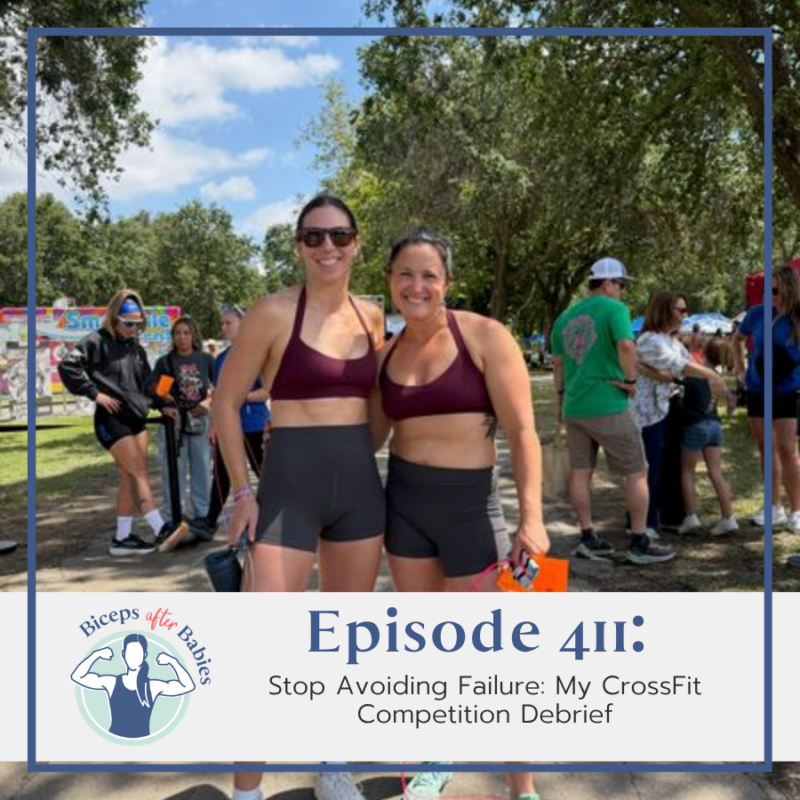
For today’s podcast, I’m taking you behind the scenes of one of the most challenging weekends I’ve ever had: competing in an elite CrossFit competition that pushed me well beyond what I believed I was capable of. I’m sharing the victories, the setbacks, and the biggest lessons I learned along the way, and why saying yes to challenges that scare you might be the key to discovering what you’re truly capable of. If fear of failure has ever held you back from going after something you want, this episode is for you.
Follow me on Instagram and Tiktok!
Highlights
- How I Met My Competition Partner 1:20
- Preparing for the Competition and Growing Anxiety 4:20
- The Pressure of Being the Weaker Partner 6:28
- Ring Muscle-Ups and Early Setbacks 8:48
- A Cardio-Based Workout 13:10
- Battling the 155-Pound Barbell 17:46
- Learning an Unfamiliar Movement: One-and-a-Half Rope Climbs 21:36
- Backwards Handstand Walks Push Me Outside My Comfort Zone 27:01
- The Heavy Dumbbell Challenge 31:22
- Lessons I Learned 34:23
- Embracing Failure and Seeking Discomfort 39:33
Introduction
You're listening to Biceps After Babies Radio Episode 411.
Hello and welcome to Biceps After Babies Radio. A podcast for ladies who know that fitness is about so much more than pounds lost or PR's. It's about feeling confident in your skin and empowered in your life. I'm your host Amber Brueseke, a registered nurse, personal trainer, wife and mom of four. Each week my guests and I will excite and motivate you to take action in your own personal fitness as we talk about nutrition, exercise, mindset, personal development and executing life with conscious intention. If your goal is to look, feel and be strong and experience transformation from the inside out, you my friend are in the right place. Thank you for tuning in. Now, let's jump into today's episode.
Hey, hey, hey, welcome back to another episode of Biceps After Baby's Radio. I'm your host Amber Brueseke and today we're going to get a little personal and I'm going to tell you the story of this past weekend of a CrossFit competition that I participated in and hopefully it will be entertaining. It'll be enlightening, maybe a little bit, um, humanizing. And I hope that you'll, I'll try to share some lessons that I learned along the way as I went through this weekend as well. So let's dive into the story.
How I Met My Competition Partner 1:20
I think that this story starts back in like 2016, 2017. And that is because this is when I “met my partner”. So my partner for this competition, which I'll be telling you about, her name is Charlie Wade and she was actually a client like way, way, way, way, way back in the day. So I started Biceps After Babies in 2016. She was probably, I could probably go look up, but she was either a client in like 2016 or 2017 like very, very early on. She was somebody I coached. So she found me on Instagram. She asked me to coach her. Um, we went through the coaching process and we've, she's kind of just stayed connected to me since then. You know, that was back when I gave all of my one-to-one clients my cell phone number. So she's had my cell phone number for years and she's come over to Orange County a couple of times because her daughter has competed in cheer and there's a big competition at the Anaheim Convention Center. And so when she does that, she'll sometimes drop into the gym that I, that I work at it because she does CrossFit as well. And so we've kept in touch over the years. She's dropped in a couple of times. I've seen her a couple of times and about a month ago she reached out to me and let me know that her partner for a competition that was coming up had blown out her knee and that she was looking for a partner. She said she quote, and I quote, accidentally qualified for the elite division in this CrossFit competition. You don't have to know a whole lot about a CrossFit. I'm going to, I'm not, I'm not going to go into like all the details, but here's a couple of things that you need to know when you're competing in a CrossFit competition. There are different levels that you can compete at. And you know, the very, very basic, basic level is what's called the scale level. And then one step up from that is the intermediate division. And then one step up from that is the RX division. And then one step up from that is the elite division.
So traditionally the elite division has harder movements. It has more skills. It has heavier weights. It's just like challenge, more challenging overall, right? As you go up each of those levels, things just get harder, right? It's like a harder, harder set of workouts that you're doing. So this competition was the NorCal Classic, which is a CrossFit semifinal competition and you have to qualify for it. So her partner, they videoed themselves doing these workouts individually and then they submit it as a team and they didn't think that they would place in elite. They thought, you know, maybe we'll be in like RX or, you know, maybe intermediate somewhere along there. And so when she says, she accidentally qualified for elite, that's what she means is like, they had no idea that they would, that was not what they were going for is to the elite division, but that's what they qualified for. So they got put in the elite division. So her friend busts her knee. She reached out to me and said, Hey, I have this competition in a month. It's in Northern California. Do you want to come join me? And maybe against my better judgment, which we can talk about later. I said, yes.
Preparing for the Competition and Growing Anxiety 4:20
I thought it would be one a fun way to push myself, you know, have something to train for for the next month to my daughters up in college in Northern California. So it was going to give me a good excuse to hang out with her for a weekend and three, like, why not? Let's just, you know, throw it out there. I did tell Charlie straight up when she asked me, I said, Hey, listen, I just got to be honest with you. Like there are some skills that I cannot do. I cannot do a strict handstand pushup yet. I always like to put the yet on there because I think that's an important thing. I can't do it yet. Uh, I cannot do like a 125 snatch, which is, it's a pretty heavy snatch. I can't do that yet. I can't do ring muscle ups yet. So there are movements that I can't quite do yet that are high skilled movements. But I told her, I was like, you know, if you know that and you still want to be my partner and you still want me to go with you, then, then I will do it. And she, she said, yeah, there's ring muscle ups in the qualifier. I doubt that they'll have ring muscle ups in the actual competition. That's a little foreshadowing for you. So I said, yes. Uh, and spent the next month trying to rebuild up some of my cardio, um, pushing myself, you know, testing out some of my skills that I have not done a whole lot of. And getting ready for this CrossFit competition as it got closer and closer. And I learned that they were not going to release the workouts ahead of time. I got more and more nervous. So in some CrossFit competitions, you will get the workouts, you know, two weeks ahead of time so that you know what you're going to be doing. You can kind of start practicing. You can kind of test out the weights. You can kind of play around with it and kind of go in with your eyes open of what you're going to be doing. Well, that wasn't the case with this CrossFit competition. With this competition, the workouts were released at the athlete briefing at 6 p.m. on Thursday. And competition started 7 a.m. on Friday. So the closer we got to the competition and the more I realized, oh my gosh, I'm going to be going into this totally blind. I have no idea what I'm going to be up against. I started to get more and more and more nervous.
The Pressure of Being the Weaker Partner 06:28
And I will say that there was a part of me too, that it's one thing to compete as an individual and to, I don't know, maybe let yourself down. It is a totally another thing to be in a team situation where you just, I just don't want to let my partner down. Right. I don't, I don't love being the weaker link in a pair. I would rather be the stronger link and give the person who's the weaker link grace. Like I would, if I'm in a pair situation, I would rather be the stronger one and then be able to give the person plenty of grace. I'm happy to like give the other competitor grace. I don't like being the weak link. I don't like being the one who is like holding the team back. And I knew going into this that like I was the weaker athlete. Charlie is incredible. She is super strong. She is wicked skilled. She, she is the stronger athlete. And that was like weighing on me as well. I was like, oh my gosh, I don't want to hold her back from what she's able to accomplish. So as I'm flying into Sacramento for the competition, all of these thoughts are like weighing on me.
So we get to the athlete briefing. I, well, I check in, you know, check in with the check-in booth. And then we get to the athlete briefing and the workouts get released. And as the workouts start getting released, my heart just stops, starts dropping because it seemed like almost in almost every workout, there was something where I was like, well, I can't really do that. Well, that's super crazy. Well, I've never, I've never done that before. Like it was like every workout. And I was just sitting here, looking at all these workouts, feeling super overwhelmed of like, I don't even know how I'm going to be able to get through this. Like I'm not gonna be able to do half of the things that are being required. What the heck am I doing in the elite division in this CrossFit competition? And Charlie said something really wise. Um, that first night, she said, let's just focus on like the next event. Like it's really easy when you get six workouts released and they all, are super scary and super crazy and super hard to like psych yourself out. Cause you're looking at the whole weekend as a, as a, as a whole thing. Instead of she was like, let's just focus on the next event. Okay. This is the next event coming forward. How are we going to break it down? What are we going to do? What part am I going to do? What part are you going to do?
Ring Muscle-Ups and Early Setbacks 8:48
So I went to bed that night, woke up the next morning, early, bright and early got into the warmup area. And the first event that we had was the one that I was most nervous about, which was the one that had ring muscle ups in it because I can't do ring muscle ups yet. I have gotten one, exactly one ring muscle up in my entire life. It was after lots and lots and lots of trying and practicing. And I was able to like eke out one and I'm really proud of that. And that was a big highlight. And it's not been something I've been able to like replicate or do over again. So I knew going into this workout that started with six ring muscle ups, no seven, there were seven ring muscle ups that I was not going to be able to do any of them. And that Charlie was going to have to do all six ring muscle ups. And then the second exercise was thrusters. So the workout went seven ring muscle ups and then 40 thrusters at a very heavy barbell for women. It was, it was 95 pounds. So normally in CrossFit we do 65 pound thrusters. And so this was a heavy barbell. So 95 pound thrusters, 40 reps. Then back to the rings. You did seven reps and then 30 thrusters. And then seven ring muscle ups and then, uh, 20 thrusters and then seven ring muscle ups and then 10 thrusters. And then you were done. Gnarly workout. Okay. Gnarly workout. So we went in knowing Charlie was going to have to do all of the ring muscle ups, which she can do. And then I was going to hopefully take over more of the thrusters to kind of like hopefully pull my weight to help her save her energy for the ring muscle ups.
Well, if you know anything about ring muscle ups, um, you know that like the longer the straps are, the harder it is. They just, they move a whole lot more. They're a lot more squirrely. It's like, it's a, it's a harder pivot around them. And in the warmup area, the ropes were really short, the straight, the straps were really short. And then you got out to the competition floor and the straps were like at least double the length. And so we, you know, Charlie had warmed up and we got to the first event and she started trying to do the ring muscle ups and she would get one and then she would miss like three and then she would get another one and then she'd miss two and then she'd get another one and then she'd miss like three. And so we're, you know, we're looking at the clock. Everybody's off the rings, right? Every other team is off the rings onto the thrusters and we are still stuck on the thrusters. And there's nothing I can do because all I can do is like, cheer Charlie on, uh, help her with her chalk. Like there's literally nothing I can do. She was super awesome and she like encouraged me. She's like, go ahead, go, you should try. Maybe you'll just be able to get one. And so I did try a couple of ring muscle ups. I didn't get them. Shocker. Um, but you know, I gave it the good old, like ever give it, give my whole try into getting that ring muscle up. Um, but you know, it just like, wasn't happening. And, um, so we're going on and people are coming back to the rings. In fact, we were talking to the lead pair, the, the people who ended up taking first place. They actually won. I think I'm pretty sure they won literally every single event.
And we were talking to them later on in the day. And they said that they, they actually thought that we had finished our thrusters and we got back to the rings and we're like on our second set of ring muscle ups. And so when they came back to the rings, they're like, Oh dang, they're like ahead of us. They've like already got back to their ring muscle ups. Nope. Um, they realized about 30 seconds in that we were still stuck on the first set of ring muscle ups. So that was kind of funny. Um, so yeah, so we ended the, uh, event one, Charlie completed six of the seven ring muscle ups and we never made it to the bar. So we spent the whole time just on those ring muscle ups and Charlie did amazing. Like she was giving it everything that she could. She was doing her very best. I just felt like all I'm doing is standing here for this workout. And I mean, I wasn't, I will say I wasn't too sad about not hitting the thrusters and the 95 pound weight because I knew that was going to hurt a lot. Um, but at the same time, like it's the first, first event you're wanting to compete. And here we are, we got time capped and we got a total of six whole reps in that first episode or that first workout.
A Cardio-Based Workout 13:10
So of course we're in last place going into the second event of the day, but this was the event that we are the most excited about because it was like the lowest skill event. So meaning it was just like, there was not a whole lot of skill involved with this. It was just cardio and how long can you hang on? This event was a row, a, um, double unders and then a partner run. So you could split up the double unders, you could split up the row, however you wanted to split it up. And then you had to grab a rope and run with each other in for like a 400 meter loop. And then we'd go back and do it again. So it was four rounds of that. And this one again is like low skill. It's like everybody can run, everybody can row double unders is, is a skill, but you know, it's a skill that most CrossFit athletes are able to, to get, um, in their journey. And so this was going to be one that was just going to be, it was going to be all like engine. It's like how much, how long can you hang on and how fast can you go? How much cardio, cardiovascular, uh, capacity do you have? And this one went pretty well. This was one of our better workouts. We ended up getting 15th out of 20 teams in this workout. And it was just a, it was just a grinder. It was just, you know, how, how hard can you breathe? How much lungs do you have and how hard can you push it on the run was essentially the workout. I watched this, I watched a bunch of teams do this workout before we got a crack at it. And the thing that I noticed was like people who went out too hot, the first couple of rounds couldn't hold it. And then by like the second, you know, third and for the elites, the fourth round, um, they started falling off the pace. And so I was like, okay, we gotta, we gotta like somewhat pace this. But who I was watching beforehand was all the individuals. They weren't teams. And so I was noticing that they weren't able to hold the pace. And so I, you know, part of me was like, we need to kind of pace this. But on the other hand, when you're doing a team, you have the added advantage of getting to rest while your partner is working. So it's a little bit different of a workout and it's a little bit different strategy. And so both Charlie and I were like, I think because you get the rest time while your partner's working, we have to push the pace a little bit harder from the get go. And so we did. And I, you know, I don't know that we were able to hold onto that pace, but it was a fun workout nonetheless. And you know, that was, that was probably the, um, I don't know the, the definitely the lowest skill. It was a lot of fun. And it also hurt a lot. Like I, my lungs hurt after that event. So that was it. That was the end of day one of competitions. I didn't basically, I basically did one workout and that was the row deadlift and the run workout. And then we were on to day two.
So day two opened with another event that I couldn't do, which was a very heavy clean and jerk ladder. So my heaviest clean, my clean PR that I have is clean I've ever done, which was like three years ago is a 160 clean. Uh, I know some people think that I'm very strong. If you're not, uh, if you don't lift a whole lot, they look at my like lifts and they look at my videos and they think, Oh my gosh, she's so strong. And I am, I am very strong. And there are a lot of people that are a whole heck of a lot stronger than I am. So 160 is a, is a decent, nothing to be sad about clean, but it is not a very heavy clean when it comes to weightlifting. So my heaviest clean is 160 and my heaviest jerk like clean and jerk. So when you clean it up to your shoulders from the, from the ground, clean it up to your shoulders and then jerk it overhead with your arms extended. The heaviest weight that I've ever done there is 145. Okay. So then we get to event three and this is a clean ladder and the weights start for our division. Cause remember where the elite division, so everything has to be harder. The weights start for our division at 155. That's heavier than I've ever cleaned and jerked in my life. Uh, so again, and I'm going and then they go up to, it was 155, five reps at 155, four reps at 183 reps at two Oh five and two reps at 215. That is a heavy barbell. A 215 clean and jerk is crazy pants for me, especially. So I was going into this clean ladder knowing, again, I cannot, I have never cleaned and jerked a 155 in, in my life.
Battling the 155-Pound Barbell 17:46
Never, never done it. Uh, so Charlie, Hey girlfriend, this is going to have to be your event again because her heaviest clean and jerk is a two Oh five. Again, she's real, real strong. And so I said, you know, I will, I will do my best. I will give it a shot. I will warm up. I will see if I can get one, but it's good. A lot of things are going to have to align. The stars are going to have to align if I'm hitting a 155 clean and jerk, uh, today. So I did, I warmed up and I did hit a 145 clean and jerk in the warmup and it actually felt pretty good. And so I was like, well, maybe I'll surprise myself. Maybe I'll be able to get, you know, the 155 and that would be super awesome. So we get onto the competition floor, barbells are loaded. Uh, I decided to go first. I'm going to see, I'm just going to see first and see if I can get the 155 and wouldn't it be just an amazing, really fun, awesome story if I'm like, and then I went out and I gave it my all and I hit that 155 and it felt so good. And I was so proud of myself. Maybe that would be a better story, but that is not the honest truth of what happened. The honest truth of what happened is I went out, I think I actually missed my first 155 clean. I think it like fell forward. Like I didn't actually even catch it. So I reset and I, and I went again and I was able to clean the 155, which is a big deal for me knowing that my PR is 160.
So I cleaned the 155 and went to jerk it and missed and try it again. Missed. Charlie comes in. She did like one or two reps. And then I was like, okay, go again. Your turn. Go again. And I was like, okay, I'm gonna try again. Cleaned it. Couldn't get the failed the jerk. Okay. She comes in. She does like two more reps. Okay. Go again. She slaps me on the butt. It's like, you can do it. You can do it. She was, she was so good at like encouraging me. Even when I was like in my head, I'm like, I cannot do this. I am, this is beyond my current capacity. It's beyond my current capabilities. She was so good at being like, no, okay, it's time to go again. Give it a shot. So I go up and again. And I, and I think overall the whole time I ended up doing five cleans, cleans at 155 and failing every single time on the jerk. Like I just couldn't get it locked out overhead. It was super heavy and it's just, it's a heavy barbell for me. Um, so, uh, Charlie ended up finishing the five clean and jerks at 155. So then I put the weights on the bar cause I just, I'll be the pit crew. I'll hype you up and I'll be the pit crew and I'll change the weights. And so then she goes for the 185 and fails it and then goes for the 185 and fails it again. And I think, you know, there's just a whole lot of fatigue doing 155 for five reps before hitting a 185 barbell.
Like it's just a lot of fatigue that you're not quite expecting that is building up before you even touch that 185 barbell. And so she failed it several times, um, and was able to get one at 185, which is, was so exciting. Like that was awesome. It's like, yeah, we got one at 185, you know, and over next to us in like the lanes, a couple of lanes over, there's girls like hitting 215 and like finishing 215 for two and finishing like the clean ladder. And, um, here we are on 185, like, you know, trying it again, trying it again, trying it again. Uh, and to Charlie's credit, like she kept going for it and she was able to hit one one at 185. And like I said, that was really exciting. And it set us ahead of some of the teams that weren't able even able to clean and jerk 185. So that was big for our score as well. So that was event three. Another event that I didn't do a whole lot in, in terms of contributing to our score. Uh, but I did feel really proud that I was able to at least clean 155 multiple times in a row and felt proud of myself for going after it.
Learning an Unfamiliar Movement: One-and-a-Half Rope Climbs 21:36
So that leads us into event four, which was the second event of day two. And this was a gnarly event. This was a sand, a hundred pound sandbag carry, and then one and a half rope climbs. What are one and a half rope climbs you ask? Well, I didn't know until Thursday I had never seen these. So with a typical rope climb, you start at the bottom of the rope, you climb all the way to the top and that's your rep. And then you climb down and you get off the rope, right? That's your one rep. And so oftentimes in a workout, you'll have, you know, three rope climbs or, or whatever, you know, I have a number of rope climbs. Well, in this competition, they were doing one and a half rope climbs. What it meant is you would climb all the way to the top. You would come down halfway. There was a tape line that you had to get your hands underneath and then climb back up to the top. It was gnarly. It was like, this is a, whoever came up with this is diabolical. Like who came up with this? This is awful. So, um, I will say going into this event, my gym that I've been training at since 2018 is underground. And so it has low ceilings. So because of that, a lot of CrossFit gyms are in like warehouses. And so they have very, very tall ceilings. And so a lot of them have ropes hanging from the ceiling that they'll do rope climbs on or rings that they can do ring muscle ups on. Because we are in a low ceiling, we don't have enough room really to do rope climbs. Um, and we don't have enough room to do rings and ring muscle ups. So we, we do have one rope in the back and we do have one set of ring muscle ups or rings for like doing ring muscle ups on. But because there's only like one of them, we don't really, they're not programmed a whole lot. And the only time I ever really see them is every year, not every year, but when they show up in the CrossFit Open. And I don't know that I've ever seen rope climbs in the CrossFit Open.
So the only time I've literally ever done rope climbs was one time when I did the quarterfinals and I had to go to a different gym and, and I had to learn how to climb a rope. Um, I had to learn how to wrap, you can wrap your feet at the bottom so that you can like push off of that. So you're not using so much of your arms. You can use some lower body, but I had to learn how to do that. Like I was the coach had to teach me how to wrap my feet to do this workout. So before this event, I think I had probably done, I don't know, in the neighborhood of like six to 10 rope climbs in my life ever before this event. And now I have to do these weird one and a half rope climbs. So I was like, bet, let's go. We're going to figure this out. Uh, so like I said, there was a sandbag carry that wasn't too bad. It was just, you know, getting your arms around the sandbag carrying that a hundred pound sandbag and then doing the one and a half rope climbs. I ended up doing four of them. Charlie did five. There was nine total. So she took five. I took four and I did them. It was so hard. The very first one I hopped up onto the rope and I completely had a brain fart. Could not remember for the life of me how to wrap my feet. I had practiced in the warmup area. I had done two in the warmup area. Um, couldn't for the life of me. I just like hung there holding onto the, holding onto the rope with my arms, trying to wrap my feet around and just not being able to get it. I don't know. I, I sit there probably for like 10 seconds until my brain like reoriented. And I was like, Oh yeah, okay. I remember how to wrap my feet.
Uh, but I did it. I was able to go up and down and back up again. And that was, you know, one rep. And I did that four times. It was hard and my arms at the end felt like they wanted to fall off my body. My triceps have never been so sore with nothing else I've ever done in my life. Like I was very proud. Um, the very last rep, the whole time I was just like, don't fail, don't fail, don't fail, don't fail. Because the worst thing in the world is to do like part of a rep and then fail the rep because now you've wasted all that energy and now you have to do it again. And so my whole time I was like, don't fail, don't fail, don't fail. And I remember like climbing up and I got to the top and I was like, okay, halfway down, go halfway down. And then I start climbing back up. And I'm like, I'm just like done. My body is done. My arms are done. My legs are done. Everything hurts. And I was just like, oh my gosh, you cannot fit. You cannot give up right now. And we're like, you have to keep going. And so even though they were like little pulls, I had like had like three more pulls and was able to like, I was, I had never been so happy in my life when I touched that cross bar at the top and was like, oh, thank goodness. I don't have to redo that rep and was able to come down. So event four was, you know, it was pretty fun. Um, it was definitely challenging. It was something new that I, I hadn't done and I did four of those climbs and actually it was, if it was one and a half times, that was actually six climbs. So I almost like doubled the amount of rope climbs that I've ever done in my entire life. I felt pretty good about that. So that was the end of day two. We ended the day in 18th place out of 20 teams. And I just was going back in my notes and my, um, my phone reel. And I realized that I just, um, put those workouts backwards. So the rope climb one was actually workout three and the bar, the clean ladder was workout four. So just, you know, for honesty's sake.
Backwards Handstand Walks Push Me Outside My Comfort Zone 27:01
Uh, okay. So that brings us to day number three. We're going into the event or into day number three in 18th place out of 20 teams and event five man was another one that was like, gosh, this is, this is testing me. Gosh, this is hard. So, uh, if you do CrossFit, you know that one of the skills is a handstand walk. You get up into a handstand position and you walk on your hands and the elite CrossFitters, man, they can like essentially run on their hands. They'll do obstacles. Like it's a really crazy balls. Um, I learned to handstand walk, I don't know, a couple of years ago. I'm not fantastic at it. I can do it. Uh, I can do it especially when it's like shorter distances because my shoulders do get fatigued. Um, but I can do it. Right. So it's like I can handstand walk. Okay. But Amber, can you backwards handstand walk? What the heck is that? So when they're announcing this event, they're like, okay, you're going to forward handstand walk, but you're also going to backward handstand walk. Again, never have seen this in any competition that I've watched. Uh, but essentially with a regular handstand walk, your back is leading, right? So you're, you're walking on your hands with your back leading the way with a backwards handstand walk. Your chest is leading the way. Never tried that before in my life. So, and again, we didn't have much time to like practice this. We were kind of just thrown into it.
So the day of I said, okay, well actually the day, the night before I was like, okay, we've got to try this backhand backwards handstand walking thing. And I practiced it a little bit and I was like, okay, I can, I can kind of do this sort of like, I'm not really good at it, but I like can kind of hold my own. And so the plan was the workout started with deadlifts. I get this 10 deadlifts at 145. That is diabolical. Like, I'm pretty sure my current deadlift is somewhere like, well, I don't know, 230. My current one RM is like, I don't know, 230, 235. Maybe back in the day when I did powerlifting, it was 303. I haven't hit that for 10 years. Okay. Now I'm talking about now. My one RM is like, I don't know, 230, 235. Um, maybe if I trained it more, I could get up above 245, but it like hitting 245, four, 10 reps. It just tells you like how fit these women are that are in this competition. It's just wild to me. Um, and so I told Charlie, I was like, dude, you're going to have to do all 10 of the reps of the deadlift. And then I will take over and I will try to do the handstand walks. So she does, she does singles. Cause I was like, you don't need, there's no need to go fast. Just single it out. We don't need to blow up your back. She did singles, repping out 245 like a boss. Cause she's boss. And I get up and I am able to do the first 15 feet of the backwards handstand walk felt really proud in that moment. I was like, yes, I'm finally contributing something to this team. The you had to do two 15 foot increments and they had to be unbroken.
So I got the first 15 feet and I just kept failing over and over and over on the second 15 feet. I got like so close. Like I would get like a hands distance away. I even got one of my hands over the line, but not the other hand. And you know, failed at multiple times. So finally, Charlie's like, okay, let me give it a shot. She gets the first 15 again. Cause the same person has to do both, both sections. So she gets the first 15 feet and then the same thing happens to her where she just keeps failing. Can't get that last 15 feet. So that's where we spent the majority of the workout was us. And I will say a lot of people that we were not the only ones who got stuck on that backwards handstand walk. It's just not something that most CrossFitters train a whole lot. Um, so we did a whole lot of handstand walking and, uh, never ever got to the other end of the, of the lane where you were supposed to do toaster bar and synchro toaster bar and synchro bar muscle ups. We never even got to that stuff. We just got stuck on the stinking backwards handstand walks. And surprisingly, this was still one of our best placings of the day. We actually placed 14th in that event. So, you know, go figure.
The Heavy Dumbbell Challenge 31:22
So then the last event of the day was actually one of my favorite. It was called lopsided and it was with a 50 pound dumbbell, which if you do CrossFit, most CrossFit workouts for females are programmed with a 35 pound dumbbell and the male RX weight is 50 pounds. This was a 50 pound dumbbell. So it was already a very heavy dumbbell and the workout was 10 burpees over the dumbbell and then a 50 foot lunge carrying the dumbbell overhead. So dumbbell extended overhead into a forward lunge for 50 feet on the right. And then you switch the dumbbell over to the left arm and 50 feet to the left. And then you had to do 20 squat snatches, hang squat snatches. So from the hang, you're lifting that bar that dumbbell up overhead to full extension. And then you're dropping down into a full squat, hips past knees. So you're going below parallel. And this one was kind of fun because it was like an I go, you go. So the first partner would do the whole workout and then the next partner would do the whole workout. And so I told Charlie, I was like, babe, you go first because you're going to be faster and better at all of these movements than I am. And I'll just take whatever time is left. I don't know if I can do these squat snatches or like, like they're going to be very hard for me. I don't do 50 pound dumbbell for a lot of movements. The lunges are going to be hard. Like this 50 pound dumbbell is going to be a problem for me. I just know it. So why don't you go first? And then, then I'll just take whatever time is left and I'll do what I can do during that timeframe.
So Charlie, she was a boss. Like she like whipped that 50 pound dumbbell, did her lunges. She ended up breaking it up into sets of four for the squat snatches and got through her 20. So that was my turn. And I, you know, did my, my burpees over the dumbbell and then had to lift that 50 pound dumbbell over my head and do the walking lunges. And I was really freaking powder myself. Like that was hard. And again, I don't do a 50 pound dumbbell overhead very often. And I was able to do the whole 50 feet unbroken, set the dumbbell down, switch to the other arm. And I was able to do like most I maybe got to like 45 feet and I had to like set the dumbbell down and had like two more reps to finish off the 50 feet. And then I got to the squat snatches and honestly, I didn't even know if I would get to the squat snatches. We kind of thought that Charlie, it might take Charlie long enough that like I wouldn't even get to the squat snatches, which I wouldn't have been super sad about, but I did, I got to the squat snatches and I was able to get to squat snatches with 50 pounds in. And I was so freaking proud of myself. Like, yes, we got time capped. We didn't finish the workout, but we ended up placing 14th in that workout as well. And that was, it was just fun because it was like hard. It was challenging. And I was able to do more than I thought I could. And like, that's always a really great experience of being more successful than you think that you're going to be going into something that was really, really intimidating for me.
Lessons I Learned 34:23
So overall, we ended up placing 17th place out of 20th and I feel really dang proud about the experience and the effort that we put in. So with that over the weekend, I was thinking a lot about like the experience as a whole, what I was learning about myself. What are some of the lessons that I was taking away from the experience? And one of the thoughts that I had, and I shared this with Charlie and I told her, Hey, you know, I'm actually really glad that I didn't know what was in store for me because had I known what being in the elite division meant, had I known what the workouts were, had I known what the weights were going to be, I would have said no when she asked me because I would have looked at that and been like, I can't do that. I'm unable to physically do those things. So I would have said no. And I'm really glad that I didn't know that because it pushed me in a way that I, I wouldn't have pushed myself, you know, just being honest about that. I wouldn't have pushed myself. I would have just said, I can't do that. And instead I was put in a position where it was like, I don't think I can do that, but we're going to try and we're going to see, and we're going to, we're going to challenge that idea of like what I think is possible for me to be able to accomplish. And I don't think I put myself in enough of those situations. I think for, you know, I think this is kind of human nature. I tend to stick to things that I'm good at. I tend to stick to things that I can be successful at. And I don't tend to start things that I'm not sure I'm going to be good at. I mean, I think, I think there's a little human nature in that. We just, we, we like to be successful. And I think in a lot of ways, it holds us back from seeing what is actually possible because what is what we're actually capable of is usually way more than what we think that we are capable of.
And that was an experience that I had this weekend of just realizing how much I tend to decide ahead of time what I'm capable of instead of going in and just saying, I don't know, let's see, let's see what I'm capable of. I don't, I don't know that I can do this, but I'm going to try and I'm going to push myself as hard as I can. And then we're going to see what I actually am capable of. And I think that that is a really good lesson for me to learn. I think, I think in my head, I'm good at pushing myself. And I think this weekend showed me that there are still places that I just don't even try because I don't think I'm capable of doing it. And I, and I want to, I want to get rid of that. I want to do more things that I'm bad at and be able to see what's, what's possible. I also think signing up for things that you're not really good at or that you think you might fail at is really valuable because there's like, there's a little less pressure, uh, around performance and more just an enjoyment of the process, right? It's just like at the end of the day, all I could do was do my best. And if I showed up and I did my best, it didn't really matter where we placed. It didn't really matter how many people beat us or how many people were underneath it, because the whole goal every day was for me to show up and do my best. And sometimes that meant not hitting a clean and jerk, right? That was my best. And you know, the lady, the woman over there is doing 215. That's awesome for her. That's her best. Uh, but that doesn't mean that my best is, is not good enough. My best is my best. Her best is her best. And I think when you show up and you do things that you're not good at, you can really just focus on, am I doing my best? And I think that that is a great, I think if we focused more often on our effort and less on the outcome or how we compare to others with that effort, we would do a lot better.
I think one of the biggest lessons that I took away from the weekend was how inspiring it is to surround yourself with people who are awesome at things, who are better at things than you are, who are inspiring, who are doing more than you can do. It was so amazing to take the field with these really, really, really fit women who could lift heavy weights and do a lot of these skills. And it was inspiring. I, I was like walking around the semifinal, just in awe of people and their muscles and their abilities and the weights that they're throwing around. Like it was, it was incredibly inspiring. And I think so often we get stuck in our frame of reference of this is normal. This isn't normal. I'm, I, you know, we compare ourselves to the people that we spend time with a lot of times. And I think getting outside that box and having your comparison be to these like specimens was really, it was really exciting and really eyeopening for me. It makes me want to go home and like practice my clean and jerks. And see what's possible when I put in some effort and put in some time and, and see what I can do, because I'm watching these women just like throw around these heavyweights and just, you know, my jaws to the ground. It's just so awesome to watch people be good at things and so inspiring to see that.
Embracing Failure and Seeking Discomfort 39:33
So overall, it was a very hard weekend. It is Monday after the competition and I am very sore. My body feels a little bit beat up, but I'm also really, really proud of how Charlie and I showed up. I'm really proud that I did really hard things that I did things that I couldn't think I could do. And then I didn't quit. And then I showed up and I put in the time and I put in the effort and I'm really proud of myself. So hopefully this is inspiring and a little bit of a reminder that doing hard things is actually really good for us. And not just doing hard things that you think that you can do, but I actually would say doing hard things that you aren't even sure that you're capable of doing. I actually just started reading the book, The Comfort Crisis, which I feel like it had its heyday a couple of years ago. So I'm a little late to the party. But one of the premises of that book is that we need to be doing hard things that like we actually aren't even sure that we can accomplish. And that's something where you're like under 50% sure that you can actually do it. It's kind of that edge where we're able to push ourselves and that we as humans need almost need that in order to continue to grow. And so I like that idea of like doing something where you're 50% or more sure that you can't do it. Great. That's, that is a great place to push yourself. And that was, I mean, that was where I was at at this CrossFit competition was like, I'm 50% sure or more that I'm not going to be able to do a 155 clean and jerk, but dang, now I'm going to go and I'm going to do it and I'm going to fail. And I think failing is actually really important because I think if we sit here and we're always afraid to fail, we will never ever see what's actually possible because our brain says all the time, you're not capable. You can't do that. That's too much for you. That's too heavy. That's, it's never possible. You can't, you can't actually make that happen. That's what our brain says to us on a, on a very often basis. And you know what? Our brain is often a big fat liar and our brain holds us back from what we actually are capable of.
So I love this idea of doing something that you're 50% or more sure that you can't do and actually failing at things. I think it's actually really good and really helpful. And I experienced that this last weekend. I experienced failing at a whole lot of things and you know what? I'm still here and I'm still around and I'm still kicking and it's such a good way to like reprogram my brain to realize that failure is not the end of the world. I'm not going anywhere. Like I'm not going to die if I fail, but I will absolutely push myself more and get further in life if I'm willing to do things and show up and fail. I would have never done a one and a half rope climb had I not been pushed. And you know what? I can do it. And that's awesome. So hopefully this debrief was helpful. Hopefully it inspired you to do some hard things yourself and to not be afraid to push yourself outside your comfort zone to try something that you might fail at and to experience the other side of what you are capable of because it's probably more than you think it is. That wraps up this episode of Biceps After Babies Radio. I'm Amber. Now go out and be strong because remember my friend, you can do anything.
Outro
Hold up sister friend. Do you love Biceps After Babies Radio? If so, the best way to say thank you is to subscribe to the podcast and leave a review on iTunes. I know every podcaster wants you to leave a review, but it's because those reviews help the podcast to reach more people. And I do truly want to know what you think. If this particular episode resonated with you, will you also please share it? Either send the link to someone who would find it valuable or take a screenshot and post it to your social media and tell your friends and family why they should listen. Make sure you tag me at biceps.after.babies so I can hear your feedback and give you a little love. And you know, if you aren't already following me on Instagram or Facebook, that's the perfect time to hit that follow button. Thank you for being here and listening to Biceps After Babies Radio.

Leave a Reply