






Show Notes
In this episode, we’re tackling one of the most common fat loss questions: how much hunger is normal during a cut and how much is too much? I’ll break down what level of hunger you can expect, when it becomes a red flag, and how to know if you’re pushing your body too far. If you’ve ever wondered where that line is, this episode will give you the clarity you need. Let's dive in!
Follow me on Instagram and Tiktok!
Highlights
- My Personal Experience: The Six-Week Cut 03:14
- Understanding Hunger: Beyond a Simple Signal 8:10
- Difference between Physical and Emotional Hunger 09:44
- Pausing and Identifying the Root Cause 14:17
- Reframing Hunger as Neutral 15:44
- Practical Strategies for Managing Hunger 21:43
- The Game-Changer: Meal Prepping 27:46
- The Power of Choosing Hard Things 32:40
- What a Privilege to be Tired in Pursuit of a Challenge You Choose 36:46
Links:
Introduction
You're listening to Biceps After Babies Radio Episode 384.
Hello and welcome to Biceps After Babies Radio. A podcast for ladies who know that fitness is about so much more than pounds lost or PR's. It's about feeling confident in your skin and empowered in your life. I'm your host Amber Brueseke, a registered nurse, personal trainer, wife and mom of four. Each week my guests and I will excite and motivate you to take action in your own personal fitness as we talk about nutrition, exercise, mindset, personal development and executing life with conscious intention. If your goal is to look, feel and be strong and experience transformation from the inside out, you my friend are in the right place. Thank you for tuning in. Now, let's jump into today's episode.
Hey, hey, hey, welcome back to another episode of Biceps After Babies Radio. I'm your host, Amber Brueseke. And today we're talking all about hunger because this is a question I get all the time from clients wanting to know where the line is when it comes to hunger, how much hunger is to be expected during a cut, how much hunger is too much. When are we pushing into, you know, doing something bad for our body? So, I'm going to be answering that question today on this episode.
Now, before I dive into this topic, I have to have a caveat because there is obviously a wide variety of people and their relationship with food and their relationship to hunger. So if we are talking about two ends of the spectrum, I would say on one end of the spectrum is someone who has somewhat of an eating disorder or a disordered view around food where they fear eating. Like the fear is around eating. They actually, you know, especially when we're talking about anorexia, they actually enjoy the feeling of hunger that is enjoyable because they've, you know, embraced that as meaning that this is working. So that's obviously a very extreme on one side. And then on the other side, we have people who really fear hunger. Like hunger is something to be avoided at all costs. It's something that they're very, very, very afraid of. And I think that those are both extremes. And the goal is to obviously find some sort of balance in between. I'm not here to glorify hunger with like disordered eating. And I'm not here to like make you scared or afraid of hunger. My goal is to help you find some balance in between that. So if you are somebody who already embraces hunger, you find, you know, satisfaction with hunger. You find yourself seeking hunger and maybe are bordering on that eating disorder pattern. Then this conversation that I'm about to have is not really for you. You probably need a podcast episode or some help from somebody that's going to help you get back in tune with hunger and honor your body more and listen more to hunger instead of like glorifying it. So I want to be really clear. When I'm having this conversation, I'm speaking to the type of woman who is afraid of hunger or finds that hunger makes you lose control or make choices with your food that you're not happy with. Or you find that you can't stick to your macros because of hunger. That's the person who I want to have this conversation with on this podcast episode.
My Personal Experience: The Six-Week Cut 03:14
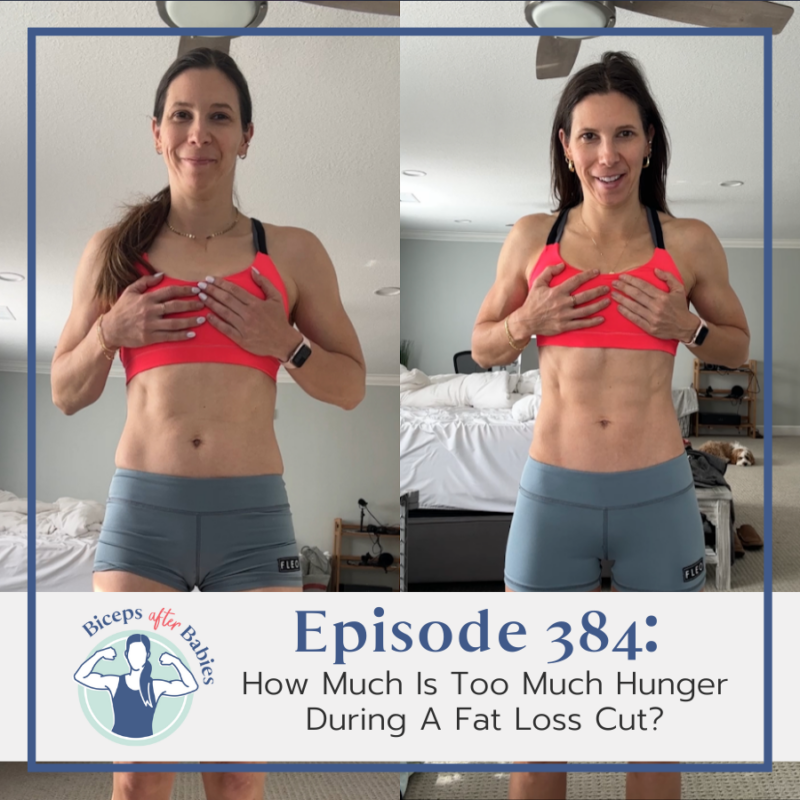
Okay. With that caveat out of the way, let's talk about why this topic is something that's important to discuss. This has been something that I've been thinking about more deeply because some of you may know that I earlier in the year did a six week cut and it's been a hot second since I've done any sort of intentional deficit. I've spent a lot of the last couple of years more just maintaining, enjoying my fitness, getting good at CrossFit, improving at my skills. And I just haven't had a need to either go into a surplus or a deficit, just kind of been maintaining and enjoying. Earlier this year, I decided that I wanted to challenge myself a little bit. I wanted to see if I could lose a little bit of body fat. And then later this year, I'm going to be going into a bulk and really focus on building some more muscle. So I had this idea that I wanted to do a cut and that I wanted to, you know, if I'm going to do this cut, I might as well take people along for the ride. So there came this idea that I had that I felt like was really genius. Hopefully you feel the same way. But I decided what, if I'm going to do this cut, I might as well take people along for the ride and show them the cut and kind of pull back the curtain and show you what it looks like for me to go through a deficit. I think a lot of times we see before and after photos, and then nobody really talks about the messy middle. Like what happened in between those photos? What ahas did you have? What struggles did you have? What adjustments did you make? And so I realized if I was going to do this cut, I might as well take people along for the journey. And so this idea of what I called watch my cut was born and I shared it on Instagram and share it with my email list of, Hey, if you want to come along for this six week journey, like in real time, it's kind of like reality television and watch the back end of my cut come and I'll just like pull back the curtain and I'll show you everything.
So anyway, I did this six week cut and it was, it was really fun. It was really fun to share it with people. Every single week I did a debrief where I went through all of my numbers. I went through what I was experiencing, both from a data standpoint and also from, you know, just my hunger levels, my energy levels, my sleep, my stress, everything to just kind of showcase, how I think about things, how I look at numbers, make decisions, how I pivoted when things got messy. And you know, when things didn't go the way I wanted to, how did I deal with that? Really? I just, I just kind of walked everybody through the experience of me going through a cut. And one of the things that I guess I was prepared for, but in the same way it's been so such a while since I've done a cut was the hunger that came up. And that was something that people had the most questions about as well is, are you feeling hungry? And then how are you managing that hunger? And then where is that line of how much hunger is too much? These are questions I got over and over and over again during this six week experience. And so it really helped me. One, I had to start to think about how I was dealing with hunger. I had to, you know, create some strategies for myself to be able to deal with hunger. And then I was able to much better speak to the people who were watching this experience on what my experience was and how I was being successful and how I was navigating and managing hunger.
And so during that experience, I realized, Hey, this is something that a lot of people have questions about. I feel like I now have some real good firsthand experience of going through a deficit, experiencing hunger myself, you know, that's different talking about something in theory versus something that you're actually going through. And so I wanted to come on the podcast and talk more about hunger. Now, as a side note, I did that, watch my cut earlier this year. Um, I recorded everything. We put it all up into a program. So if you're wanting to, you know, it's obviously not live anymore. It's obviously just the recordings from everything that I did during my cut. But if you're like, Oh man, I missed that. And I really want to go watch that experience. And you totally can. Um, if you go to bicepsafterbabies.com/watchmycut, you can go and purchase that. And everything is, it's kind of like when your favorite reality TV show, like releases all the episodes, they're all there now for you to binge people who did it in real time with me, like got an episode every week, but now they're just there to binge. So if this kind of piques your interest and you want to see the, you know, me pull back the curtain on my experience of my cut, you can go to bicepsafterbabies.com/watchmycut and you can see all the messy metal. Okay. So anyway, that's, that is what made me want to do this episode and made me realize that this is a conversation worth having on the podcast to be able to share with you, um, so that you can navigate your cuts better, that you can navigate hunger. So you can know it as normal, know how to deal with it. And then know when you're pushing a little bit too far into feeling hunger.
Understanding Hunger: Beyond a Simple Signal 08:10
So before we dive into all of the specifics about how to manage hunger, we have to talk about what hunger is, because I think one of the issues that a lot of people struggle with in terms of their relationship with hunger is that they don't really understand hunger cues. And to be honest, hunger is very complex. I think sometimes we try to boil it down and make it really simple. Like if you're hungry, your body needs food. And if you're not hungry, your body doesn't need food. And I, I wish it was that simple that, but hunger is way, way, way, way more complex of a process in our body with lots of hormones and lots of cues and lots of ways that those cues would be activated, that it is not just as simple as I feel hungry. That means my body needs more food or vice versa.
Now I'm not going to get into all the biochemical pathways because frankly that is beyond the scope of my expertise, but two hormones that you will often hear a lot talked about in terms of creating hunger cues in our body are ghrelin and leptin. And ghrelin is, I always think about it, ghrelin makes your stomach growl. I don't know. That's probably from like nursing school, but ghrelin is the hunger hormone. It stimulates appetite. Whereas leptin is the opposite. It is more of the satiety hormone where it makes you feel full. So ghrelin and leptin levels will fall and rise based off of many, many factors. And that is often at least the main hormones. There's lots of hormones, but those are the main hormones that we usually associate hunger with.
Difference between Physical and Emotional Hunger 09:44
But again, there is not this direct relationship between I am hungry and my body needs food. And so it can be a little bit difficult to navigate hunger because there's so much nuance there. And one of the things that I find clients struggle the most with is the difference between physical hunger and emotional hunger. So honestly, if you, if you can start to tease these two pieces apart in your own journey, this is going to be huge for you because a lot of times when we are eating, it is from emotional hunger, not actual physical hunger, but we get them confused, right? This is where stress eating comes into play or eating because you're sad or eating because you're lonely or eating because you know, things didn't go well or whatever, right? That, that is emotional hunger. It is not physical hunger. So this is a skill that is really important to develop. The being able to differentiate in yourself and in your body, the difference between physical hunger and emotional hunger.
So what are the, some of the ways that we can tease that out? Physical hunger is often broad in your desires, meaning when you're physically hungry, you're usually willing to eat a wide variety of foods. Whereas when you're emotionally hungry, often those food cravings are very specific. Like I'm craving chocolate or I'm craving chips. It's a specific food that your, your body is saying that it wants. That's typically emotional hunger. Whereas physical hunger is more like I'm just hungry. Like I would eat anything right now to be able to help with that hunger. So that's a huge one. The other, another one that's really valuable to tease this out is that physical hunger will come along with physiological cues, like a growling stomach, right? You'll have physiological manifestations of that hunger. Whereas emotional hunger typically does not have the same physiological manifestations. It's like it's a hunger, but it's not like you don't feel it in your stomach type of hunger.
Physical hunger also is something that will gradually get greater and greater and greater over time. Whereas emotional hunger tends to be much more of a sudden onset. Physical hunger, you're able to eat and, and feel full whereas emotional hunger is not really connected to physical hunger. So there's more of that not ability to satisfy, right? This is where binging tends to come in or overeating because there's no, you're not actually physically hungry. And so we're not able to have like a physical cue of fullness. It's, there's a, just a continuation of eating. Physical hunger often feels manageable. Whereas emotional hunger tends to have a feeling of desperation around it. Like I need this food and I need it right now. Physical hunger is usually something that we can satisfy around other people. Whereas emotional hunger is often done alone. This is often where you're like eating in the cupboard, sneaking food because there's a lot of shame associated with it as well. And with physical hunger, again, you can have, you can feel satisfied after eating. You can eat something, you can feel satisfied, you can feel full and you can move on. And that doesn't typically, it's not typical experience when it comes to emotional hunger. Often you eat past that feeling of fullness into a feeling of like you're stuffed. And, you know, it's just a very different experience from satiating physical hunger.
So when it comes to hunger, developing the skill of being able to differentiate between, am I physically hungry or am I emotionally hungry is, is such a huge milestone because a lot of times I find clients are confusing the two and it makes them almost fear physical hunger more because they're so used to emotional hunger, which has this element of lack of control with it. When most people are talking about stress eating, they're talking about eating lots of highly palatable, high calorie foods in secret to a point of over fullness, right? There's like a loss of control in, in eating. And that can really create this, this fear around food, this fear of losing control around food.
Pausing and Identifying the Root Cause 14:17
So if this is a skill that you want to work on developing, really putting a pause and asking yourself the question, am I feeling physically hungry or am I just experiencing emotional hunger is such a huge milestone. Like if you can just do that one thing and answer that question, honestly, is this physical hunger, is this emotional hunger that will do so so much for your journey? Because if you are experiencing emotional hunger, you're experiencing sadness or stress or even happiness. Eating isn't going to solve any of those problems. It's only going to make, you know, it makes you feel better for a hot second. That's why we do it. But in the end it's not going to meet any of those emotional needs. And so being able to distinguish, is this emotional hunger? Is it physical hunger? And if it is emotional hunger, what do I actually need right now will solve a lot of problems. So if you're feeling stressed and you're feeling that emotional hunger, you're feeling that pulled to the cabinet to go eat a bag of chips, pausing and saying, am I feeling emotional hunger or physical hunger? This is emotional hunger. What emotion am I actually experiencing? I'm feeling very stressed with my work. What is something I could actually do to address the stress that would actually bring that stress down? Well, maybe I need to go do a five minute meditation or go for a walk or go sit in a bubble bath. Those are things that are actually going to bring your stress level down. Eating isn't going to solve that emotional problem. So, okay. So that's a really important point is being able to distinguish between physical hunger and emotional hunger. Now, the rest of the time we're going to be talking about actual physical hunger.
Reframing Hunger as Neutral 15:54
I think it's really important when we talk about hunger to frame it as neutral. Hunger is a signal. That's all it is. It is not an emergency. And I think a lot of people equate it with an emergency. It is not an emergency. It is not good. It is not bad. It is neutral. It is simply a signal from your body. And I think if we can really get away from this fear around hunger or this fear that we have to avoid it at all costs, we can develop a much better and a much healthier relationship with hunger. So how, what relationship you have with hunger is going to affect your success during a cut. And that's why I think really get into the space of like neutrality of just, again, it's not good to be hungry and it's not bad to be hungry. It just is a signal. It's something your body is communicating to you. And then you get to decide what you do next with that. So the reality is during a deficit, it is likely that you will feel hungry.
Now I want to be careful and say, it's not required. You can lose fat and not be hungry. I find, if this is your experience, I find it is more likely your experience if you have more fat to lose, but not always. Okay. So you can lose fat and not be hungry. But the truth is the leaner you are, the more likely you are to feel hungry in a deficit. I mean, I'm currently eating at maintenance, if not even like a slight surplus, and I still feel hungry sometimes. Okay. So again, there's not this one-to-one relationship with hunger and like what your body needs.
Now, I see a lot of women get tripped up here because they have been conditioned to believe that hunger equals fat loss. If I'm hungry, I'm losing fat. And if I'm not hungry, I'm not losing fat. And I think there's a real danger in creating this causational relationship between hunger and your body's caloric needs. Honestly, hunger is way too complicated of a signal hormonally for you to boil it down to like something so simple. So I choose to view it as feedback. It's information. It's a signal. And then my job is to take that information and make a conscious decision. So I don't treat hunger as a problem. I don't treat it as an emergency, emergency. I treat it as data, as information. And then I figure out what I'm going to do with it.
Now, when we talk about hunger, it's important to acknowledge that it's also not a light switch. I made that distinction between emotional hunger is very quick to turn on, right? It's like, Oh, I have a craving all of a sudden. Physical hunger is not on or off. It is a spectrum. And that's another really important piece of feedback. The level of hunger that you're feeling is very important, right? You can be starving. You can be really hungry. You can be kind of hungry. You can be neutral. You can be satisfied. You can be full and you can be stuffed. It's not a binary. You're not either hungry or you're not. You're somewhere along the hunger spectrum.
And so that brings to the real question that a lot of people want to know the answer to how much hunger is okay. Where on that spectrum is it okay? Honestly, I think it's really important to remind you that hunger is not going to kill you. So when I'm answering this question for myself, what I'm really thinking about is how much hunger can I tolerate and still stay in control? Because hunger that leads to poor food choices, to loss of control, or even binging is absolutely what we're trying to avoid. That's obviously going to slow down your progress. If you're so hungry that you're losing control, you're overeating, you're making poor food choices. That is going to in the long run, slow down your progress. So there is no chart. There is no place where I can tell you, here's where the line is. What you need and want is curiosity and self-awareness around where that line is for you.
So you can ask yourself some questions like how hungry do I feel before I eat? And then how do I feel after I eat? At what point of hunger? Do I notice that my decisions start to slip? Am I falling into that getting so hungry that I feel loss of control? Am I eating because I'm hungry or am I eating because of habit or stress or boredom? So getting really curious about levels of hunger that are maintainable for you is a really important step into figuring out that line of how much hunger is okay. Because it's not, it's not a generic, it's not a how much hunger is okay for every person on the planet is like this point. It's how much hunger are you going to be able to maintain and stay in control? And that's going to be different for everybody.
This is why I love macro tracking and I love macro counting because it becomes a tool to help you learn your body. Not just hit numbers, not just like follow a plan, but it helps you to understand, Hey, when I create a 500 calorie deficit, it is that creates too much hunger in me. I can't maintain it because I then will overeat because I'm so hungry. That information is so valuable for yourself to know where that line is about how much hunger you're able to work, work alongside with.
Practical Strategies for Managing Hunger 21:43
Okay. So we've talked about reframing hunger. It's not good or bad. It's just information. We've talked about how do we sort of find that sweet spot of recognizing that, Hey, the leaner you get, the more hunger you're probably going to have to deal with. And yet we want to be able to deal with it in a way that we're able to tolerate the hunger and not lose control because of it. So how do we manage that? What are some strategic ways that we can manage hunger? Uh, I will share, what I'm going to share is what was helpful for me. Did I experience hunger during my six week cut? Yes, I did. Did I feel like I managed it well in that I was able to find a sweet spot where I was experiencing hunger, but I was able to manage it as efficiently as possible and I didn't lose control because of it. Yes, I was able to find that sweet spot. And if you go through watch my cut, you'll kind of hear me talk about some of the ways that I would tweak my numbers or ways that I would adjust my macros to be able to, again, sometimes eat a little bit more, sometimes eat a little bit less in order to find that sweet spot that worked for me.
But let me show, share some of the strategies that I specifically played around with and that I used that helped me not get rid of hunger. I still, I still was hungry at, at points, but helped me to mitigate it as much as possible. And that was really, my goal was not to never feel hungry, but to be able to mitigate it so that I wasn't like incredibly hungry all the time. So, and these are very practical. These are strategies that you can play around with. Maybe they'll work for you.
Maybe they won't. How did I figure these out? I just got curious and I played around with strategies and I found the ones that were helpful for me. So that's what I'm going to kind of share right now.
One of the ones that was very helpful was sparkling water, having something to be able to sip on, especially in the afternoon or when I was making dinner, that's like such a go-to for me. It allows me to feel like I have something a little fancy, a little special. If you follow me on Instagram, you've maybe seen that like sometimes when I'm making dinner, I'll pour like my sparkling water into like a wine glass. And it just like makes me feel fancy while I'm drinking something that is zero calorie. Along the lines of that, caffeine can be actually a pretty good appetite suppressant. So I will use caffeine strategically during the day to be able to give me a little bit of energy boost, but also to be able to help with some of those hunger cravings. So oftentimes it was a sparkling water in the afternoon, but sometimes it would be like a diet Coke to give me again, some of that carbonation in a zero calorie beverage. And then also just a little bit of caffeine that can help with reducing hunger.
I definitely use distractions to be able to help me kind of push through hunger. Like sometimes I would just power through with my work or oftentimes I would go out and take a walk around the block or I would put on a meditation. So distraction can be a really helpful way to, again, not when I'm like starving, starving, starving, but when I'm feeling hungry and it's not, I'm not wanting to eat right now or I have a plan for when I'm going to eat in the future, being able to do something to distract me to push me out a little bit further was really helpful.
Fiber, fiber, fiber, fiber and fiber and high volume foods. This is such a key to minimizing hunger, increasing my fiber, really focusing on that fiber content and making sure I'm hitting my fiber and then really prioritizing high volume foods. It is very easy to consume a lot of calories in low volumes and still feel hungry, right? You could eat like four tablespoons of peanut butter and consume 400 calories very easily and still feel very hungry. Or you can consume 400 calories with a big salad, some protein and some avocado on top and you can have 400 calories there and it's this gigantic bowl of food. So really focusing on having enough fiber and that's something that I really track and pay attention to and really am intentional about hitting during a cut and then specifically what foods am I choosing and I may choosing high volume foods. I try to get veggies in at every single meal, especially when I'm on a cut because it increases the amount of volume that I'm able to eat and more volume makes me feel more full. It makes me feel more satiated. I get a longer time to be able to eat. So those two pieces, high fiber and high volume foods is like a non-negotiable when you're going into a deficit, in my opinion, if you're wanting to minimize hunger.
Something that was really helpful for me was having a schedule for when I would eat and I kind of, I wasn't rigid about this, but I kind of developed this cadence and this pattern of, you know, what times during the day I would eat and I would eat very similar things during those times. So it was very helpful for my mind to know when my next meal was, right? So I would eat breakfast when I would come home from the gym and then I would know that my lunch would be around 12 or one and I had done this yesterday so I knew about how much hunger I would have at 12 or one and then I would eat, you know, a snack in the afternoon and then I would have dinner at my normal time and then I would have my creamy afterwards. And just knowing when my next meal was going to be for me mentally allowed me to keep going. I think of it like if you're running a 5k and there's no finish line and you're just supposed to just keep running until someone says you're finished, that would be much harder mentally than if you know exactly where the finish line is. And so for me having a cadence for how my meals were planned out when I would have those meals and then just sticking to that routine allowed me to say, Hey, I'm starting to feel hungry, but I know in an hour and a half I'm going to have lunch. I can make it an hour and a half till that next meal.
The Game-Changer: Meal Prepping 27:46
And then my last strategy that was was really a game changer for me. And it's not anything that I've done a ton of previously, but it is something that I implemented during my cut and I have continued on even after my cut and that is meal prepping. I don't know why I've never been much of a meal prepper. Well, actually I do know why. It's because I work at home and I'm always home and my kitchen is right there. And so I never really thought that I needed to meal prep cause I'm not leaving the house or needing to take meals with me, but I utilize meal prep during my cut and it was a complete game changer. I would meal prep my breakfast and my lunch and then I would have the same thing for breakfast and lunch, like three to five days in a row. It made tracking so fast. I just literally copied and paste my day, like five days in a row, just copy and paste, copy and paste, copy and paste. So it made tracking so easy. Um, I would, I would meal prep my breakfast, my lunch and my creamy for dinner. Uh, and then what was the wild card was just usually my, my dinner. And that would be something that I would eat with my family. So that would be a little different every day, but not having to think about breakfast, not having to think about lunch and not having to think about my creamy and just being able to like eat those foods and then really, really easily log them. For me, it was just a game changer. I can't even, I can't even say how crucial meal prepping was to the success of my cut. I don't think I will do another deficit without meal prepping. For me, that was, it was really a game changer and it was meal prepping. So like putting the time ahead to put together my meals. Uh, but then it was also like not having to think about what I was going to eat. Not having to track it.
And then the third thing that I think people don't think about is it like, I think of it kind of like what I was talking about with the 5k of like knowing the finish line. It was like, I knew how hungry I was going to be. If that makes sense. It's like, I ate this breakfast yesterday and I knew about how hungry I was for lunch. And then I ate my lunch and I knew how full I got. And then I knew how hungry I was going to be for dinner. And just being able to expect that made it so much less mental for me. It was like, I know that I can make it to lunch because I did yesterday. And I know about how hungry I was. And then I know how full I felt at the end of lunch. So I I'm okay. Like I can be okay for me. That was such a game changer to just have a cadence, know what meals I'm going to eat. And then, you know, I ate the same meals, Monday, Tuesday, Wednesday, Thursday, Friday. So I knew about how much hunger I was going to have to deal with. And so it wasn't, it wasn't such a mountain for me, if that makes sense. So that was something that I wasn't really expecting when it came to meal prep, but something that was very, very, very helpful in terms of hunger management was just having a routine, a cadence, eating the same foods over and over. It made tracking so, so much easier. It made hitting my numbers so, so much easier. And it just took a lot of the thought out of the whole entire cut process.
Now I did get somebody asking me a question about what do you do if you like meal prep, but then you like, don't want to eat it right. This, this like rebellion mindset that some people have where it's like, I just want variety. And I just, I don't want to eat the same food every single day. Fair enough. Totally fair. The way that I approach it and the way that I look at it is that this all comes down to what has a higher value for you. Do you value ease or do you value variety? For me, I would rather sacrifice variety to make it easier on myself to get results. And that's what, that's what like meal prepping did for me was like, yeah, I ate the same food most of the days in a, like in a row. I would change it up every week, but like Monday through Friday, I would eat the same breakfast. I would eat the same lunch. I would eat the same creamy and then dinner was different. For me, my ease and results was a higher value for that period of time than variety.
Now you may be the opposite. Maybe variety is a higher value for you and great. And you, you can prioritize that value, but you have to recognize that it may be a little harder. It may take a little bit more time and it's probably not going to be quite as easy. So this isn't a, which one's better or which one's worse. It is a, which one is a higher value for you, for me, for six weeks, eating the same foods Monday or Monday through Friday was, and the ease and the less tracking it required of me was all worth it to have not as much variety. But again, that's the choice that you get to make based off of what's your highest value.
The Power of Choosing Hard Things 32:40
Okay. And the last conversation that I want to have around hunger is framing around the power of choosing. And I think that this can't be overstated enough that when humans are very adept at doing hard things, if two things are in place, if it is that the outcome is something they desire, right? Like on the other side of the hard thing is a good outcome that they want. And if it's something that they are actively choosing to do.
So I think about something like pregnancy, like pregnancy is really hard. Labor is really, really hard. We as humans do a very hard thing when we do pregnancy and labor, but we are able to do it because on the other side we get something amazing, right? We get a baby. And because on some level, like most of us choose to be pregnant, or at least we choose to stay pregnant and deliver this baby. So there's like an element of like, I'm choosing this, I want this. And that allows us to do hard things.
I think about the same thing when it comes to a deficit or going through a cut or feeling hunger. I was able to really frame out in my mind that when I was hungry, I, again, it wasn't an emergency. It was a signal to me. It just meant to pay attention. But I could remind myself that I was choosing a deficit. I was choosing it for six weeks. I could choose to not do it. That would be totally fine. But I was choosing this hard thing. And when you choose a hard thing, your ability to be able to push through the hard thing is so much higher. I once heard a quote that I don't remember who said it, but I have held onto it as well, that the hard days count twice. Because the hard days are the days where when you push through, that's really where the needle starts to move. And I found that really true in my life, that the hard days count twice. And so on those days that I was a little bit hungrier, I would remind myself, this is like the mental work that I did. I would remind myself that I choose this, that I can choose something different at any point. No one's forcing me to do it. I don't have to do it. I'm choosing it. I have a time period that's set for it. That's also really important. I knew that I was going to be done with the cut in six weeks. And then I would remind myself that the hard days count twice.
Now there were days where I intentionally chose to eat more. So it's not like I white knuckled this whole experience or I white knuckled being hungry every single day. There were days that I would give myself more food. There were days that I would do refeeds. I walk through all of this inside watch my cut. If you want more of the details of how I navigated this, but there are days that I chose to eat more food, but I did it from a proactive versus a reactive mindset. And I think that is a really important point to make. The more you are proactive about making decisions and not reactive, that's where like the loss of control is. It's like when we just react to things and we don't actually logically think them out, we don't logically plan them out. So I would remind myself, I choose this, the hard days count twice. Um, I, I am, I have a set timeframe for this and that allowed me to have the mental capacity to be able to push through on days that, you know, I was a little bit more hungry.
I also think we cannot talk about hunger without mentioning that hunger is really modulated by sleep and stress. So this is, again, this is why hunger is so complex. It is not just how many calories your body needs. If there's lots of research that shows that if you don't get enough sleep, you're going to be more hungry. If you are experiencing higher stress, you're going to be more hungry. So in my cut, you can see that some of the things that I, I, I collected data about like, what was my sleep like? What was my stress like? Because that can absolutely play into hunger and your experience of hunger.
What a privilege to be tired in pursuit of a challenge you choose 36:46
All right. To wrap up this conversation about the power of choosing, I saw this quote on TikTok and I loved it, loved it, loved it. And it's something I've come back to and thought about over and over again. And it was somebody saying, what a privilege to be tired in a pursuit of a challenge you choose. What a privilege to be tired in pursuit of a challenge you choose. And again, I think it just goes back to that. If you're doing this because you choose it because you want it versus because you think you should do it or somebody else thinks you should do it, you're going to be so much more successful if you're really doing it because you want to do it and because you choose to do it. And I can't state that high enough when it comes to cuts are hard. They are, there's, they're challenging. They're going to press or push you. They're going to stretch you. But if it's something that you choose, if there's a time limit on it, if you are, you know, thinking about it strategically and managing it effectively, it doesn't have to be miserable.
I was not miserable during my cut. I actually really enjoyed the process. It was really, it was something different. I had to think about it. I had to plan for it. I had to, you know, change the way that I was doing things, but overall it was a very enjoyable process and I got really, really fantastic results. I was very happy with the results, how my body responded to the experience. But it wasn't miserable the whole time. And I think, again, it's because I chose it. I wanted to do it. I set myself up for success. I was able to manage and mitigate hunger as much as possible. I was able to be responsive to my body. Again, if you go through Watch My Cut, you'll see how I responded to my body, how I looked at the data, how I looked at the numbers and made decisions based off of the data, how my body was doing and made adjustments throughout the process. You'll see that all in Watch My Cut if you go, if you go through it.
Key Takeaway 38:43
So overall, I hope that you're taking away the power that we have to be able to be intentional about going through a deficit, managing hunger, that it is not an emergency. It's a cue, it's a signal, it's neutral. And that there are a lot of things that you can do to be able to mitigate it. We don't have to be afraid of hunger. There are ways to be able to lessen it. And if you're getting leaner, hunger is probably going to happen. And just kind of accepting that, not loving it. I'm not getting into that, like eating disorder of like chasing it and wanting it and like, thinking it's the best thing in the world, but we also don't have to fear it and we don't have to be so afraid of experiencing it. It's not going to kill you. It is a signal from your body. And then from that you can make decisions with your brain about how you want to handle it, how you want to manage it and set yourself up for as much success as possible during a cut.
All right. So if you're wanting to watch me pull back the curtain, you can go to bicepsafterbabies.com/watchmycut. And like I said, I already did this early in the year. So all of the videos, the debriefs, the numbers, everything is already done and you can like binge watch all the weeks of content. And if you want to do that, you can go to bicepsafterbabies.com/watchmycut. All right. That wraps up this episode of Biceps After Babies Radio. I'm Amber. Now go out and be strong because remember my friend, you can do anything.
Outro
If you've ever wondered what it actually looks like for me to coach you through your weight loss journey, here's your answer. Some of my most powerful podcast episodes aren't interviews or my solo rants. They're real raw coaching calls straight from inside MACROS 101. You'll hear women just like you working through plateaus, perfectionism, and the I'm doing everything but nothing's working spiral. These live coaching shows show you exactly what it sounds like to break through the mental junk that's been keeping you stuck.

Leave a Reply